


Will Hinson said size and profile matter when trying to make a finicky crappie eat an artificial lure.
Cracking the Crappie Code: Lure Size and Profile Matter
Story and photos by Terry Madewell
When tempting a finicky crappie to eat an artificial lure, anglers must meet the needs of the fish – not make the mistake of trying to push their personal preference over what the fish really want.
Experienced anglers know many factors are involved in finding the right lure for the specific scenario you’re fishing, because a crappie’s diet is diverse, changing seasonally, even daily.
The decision of which lure is best hinges on many factors, but to consistently entice crappie to bite and ride home to sizzle in your pan, lure size and profile are often the keys to controlling your own success.
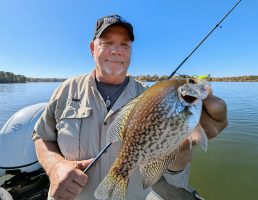
Will Hinson from Cassat, SC, is a highly successful tournament angler with more than 40 years of experience catching crappie throughout the southeast. When he’s not fishing tournaments, he is often teaching others the fine details of using forward-facing sonar (FFS).
“The challenge of making a crappie bite is a major reason I love crappie fishing, and for me, that process begins with lure size and profile,” he said. “I love to catch and eat crappie, and some days it’s simple; just do the same as the previous successful trip. But if it were always easy, I’d probably be fishing for something else, because part of the attraction to crappie is their finicky nature. And solving the lure choice riddle is a challenging, but fun adventure.”
Hinson said daily weather conditions, as well as water color, temperature, and seasonal patterns, affect the bite. The period from pre-spawn through post-spawn, when crappie movement is continuous, certainly affects the lure parameters for catching crappie.
But their finicky nature is a year-round challenge.
“Successful lure selection is fundamentally linked to the crappie’s forage,” he said. “Like all fish species, crappie must eat to live, and available forage impacts lure preferences. I’m a strong believer that the size and profile of my lures matter, and they impact the ultimate solution.”
“The size and profile, matched with the size of the jighead, impact the speed the lure works through the water column,” Hinson said. “This also impacts the depth I can effectively fish, and depth is vital. And I want the profile to mimic the forage crappie are utilizing at that time.”
From the crappie-lure industry perspective, Tom Mundy, owner of Fish Stalker Lures in South Carolina, said the diversity of natural food choices is why lure manufacturers produce a wide variety of lures.
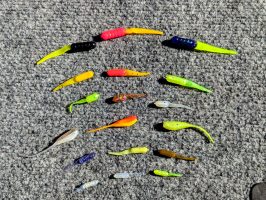
“Crappie fishermen require options in lure size and profile to succeed consistently,” Mundy said. “From the perspective of a lure manufacturer, the favored lures during a year vary from large to tiny. I make lures from a 2.5-inch plastic grub, with my 2-inch version being popular, but seasonally the 1 ¾, 1 ½, and one-inch grubs, along with varying body profiles, are what anglers purchase, because that’s what crappie require.”
Mundy said that versatility in lure size and profile is crucial, and that anglers must be willing to make changes until they work out the pattern. Identifying the crappie’s natural forage and examining their stomach contents helps anglers match the hatch in size and profile, increasing odds of success.
Hinson said that when on a consistent lure pattern with a specific size, profile, and color, that pattern may remain consistent for a while, but eventually it changes.
A case in point occurred on a winter trip with Hinson in 2025. We fished large schools of roaming crappie, starting with a 2-inch Slab Tail (Fish Stalker) body in the Mountain Dew pattern. Despite his recent success with that lure size and profile, our day began with a slow bite, although the Forward-Facing Sonar (FFS) depicted our lures working around scads of crappie. We tried multiple techniques first, then Hinson reduced the lure size to 1.5 inches, then to 1 inch, while also reducing jighead size.
Each tweak improved success, but he was still not satisfied; he reduced the splitshot size above the lure. Each change affected the lure’s fall rate until we could fish the bait slowly, right at the top of the schools of crappie, and keep it in the strike zone longer. The size of the lure and the smaller jighead, combined with a smaller profile, were significant changes. Coupled with the reduced splitshot weight, Hinson had significantly improved speed and depth control. The crappie readily ate this presentation, and the catch rate and fish size improved. We were happy fishermen once Hinson solved the riddle.
Hinson said another factor is lure color, but he checks color after he’s worked on size and profile changes.
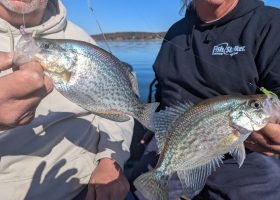
“Unless we experience a significant change in water color, I work size and profile angles first,” Hinson said. “On some days, it may be the color that’s the final piece to the puzzle, but seldom is the color pattern the sole issue.”
Tom Mundy said that using different lure patterns and colors when fishing with a partner is a good idea, allowing anglers to compare lure success.
Hinson said that tournament anglers understand tweaking their lures is essential when the bite slows. If the current pattern isn’t productive, start the process immediately.
“Don’t simply hope you will get bites, take control of your success by working with size, profile, and other options,” he said.
Anglers without FFS can follow the same advice, because they’re usually fishing areas where they’ve enjoyed previous success, so odds are good crappie see their lures, but aren’t biting.
The big-picture goal for Hinson is to catch slabs, and solving the daily riddle of how to improve the crappie-catching process adds another layer of lore to that trip, making him eager for the challenges of the next finicky-crappie adventure.
You can reach Will Hinson/Livescope Consulting at 843-618-5776.
Terry Madewell of Ridgeway, S.C., has been an outdoor communicator for nearly 50 years. He holds a degree in Wildlife and Fisheries Management and has a long career as a professional wildlife biologist/natural resources manager. He’s passionate about sharing outdoor adventures with others.
