

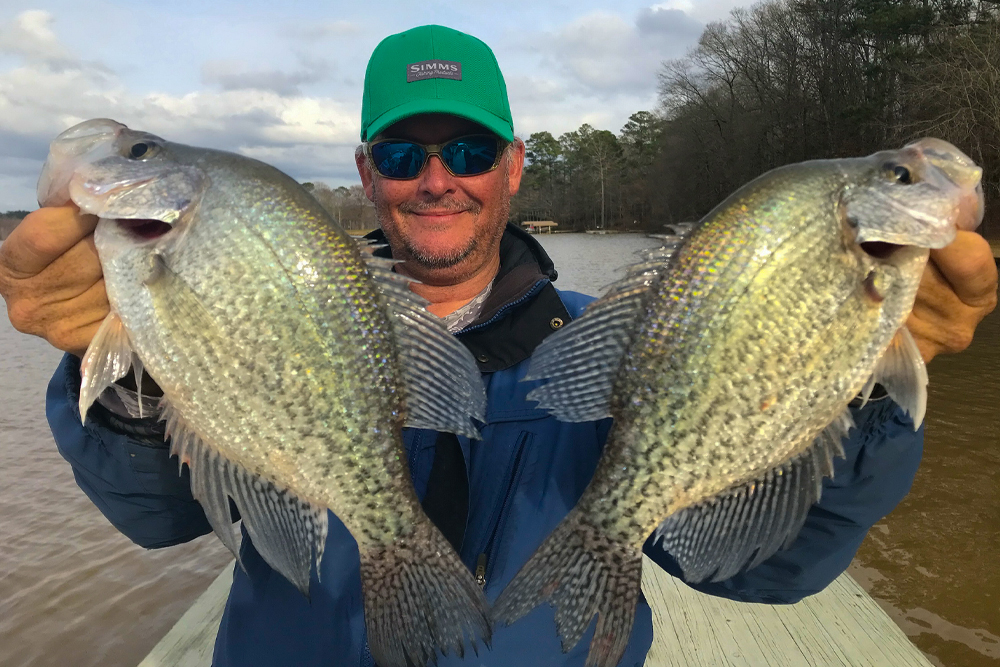
Capt. Doug Nelms displays two of the slab crappie that are
caught in large numbers on Lake Oconee. (Photo by Anietra Hamper)
Year-round Crappie Challenge on Georgia’s Lake Oconee
By Anietra Hamper
In the heart of the Reynolds Lake Oconee community in central Georgia, located between Augusta and Atlanta, sits some of the best black-crappie fishing in the state. The bonus is that the year-round fishery with more than 370 miles of shoreline gives crappie anglers a way to test new techniques by the season whether they are looking to fill the boat with numbers or land a personal best with size.
“We have a lot of forage here. We’ve got threadfin shad and gizzard shad, but the
threads are smaller, so the crappie have plenty of food to eat,” said Capt. Doug Nelms, owner of BigFishHeads guide service.
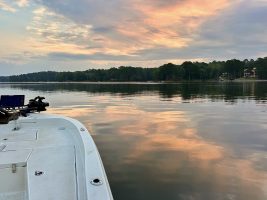
As the morning fog lifts off the water at Lake Oconee, I set out with Capt. Nelms to experience first-hand why this lake is a prized destination for crappie anglers. Nelms grew up in the area and has fished this lake for nearly 30 years. He knows almost every submerged forest and structure, including entire homes that lie beneath the surface of this 19,000-acre lake. Nelms oversees a team of fishing guides and charter-boat captains who serve the Reynolds Lake Oconee community’s members and their guests, as well as visitors to The Ritz-Carlton Reynolds Lake Oconee.
The abundant structure and submerged brush give the crappie plenty of places to hide, feed and spawn. Besides the lake’s abundant habitat, another advantage for Oconee crappie anglers is the lake’s consistent water level.
“Since Oconee is a pump storage facility, this lake never goes down more than two feet in a day,” said Nelms. “It’s got a pump back system, and in the middle of the night, they turn four of those six turbines around and fill the lake back up. You may come down here tonight and look at your dock and go, oh, the water’s down two feet. But in the morning, when you come back, it’ll be full.”
Lake Oconee anglers need to learn specific fishing techniques that work best during each season. But Nelms says if he had to choose a best time to target black crappie, it would November to March.
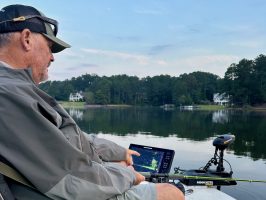
“Our really big fish show up in February and March, and we do what we call pushing. We’ll fish with live bait. We’ll do some open-water fishing, like using the LiveScope and you’ll see the fish and run up on them. We have long poles (15-16 feet), and we’ll drop a bait right on them and they’ll attack it. Those are the really big fish,” said Nelms.
In April, May and June anglers do best with longline trolling behind the boat. Nelms pulls a tandem rig with curlytail grubs trolling eight to 12 rods off the back of the boat with an electric motor at speeds of no more than 0.5-0.6 miles an hour.
“They’re behind the boat, and we want to have that grub tail action when we’re pulling them. And we’ve got two of them like that. Grubs, stingers and things like flies, jiffy jigs, we call them little hair jigs,” said Nelms.
During the summer months and into the early fall (July, August, September, October) the black crappie move out of the river channel and back onto the trees. With more than 1,800 acres of submerged timber in Lake Oconee, this is when anglers can get active with live bait and aim for larger numbers of fish even in the heat of the day.
“These fish will pick out one tree, and they’ll just bunch up on it like a herd of cattle getting under a tree when the sun is hot,” said Nelms. “You can catch them through the middle of the day when the sun is beating on the water. They have really big eyes, and their eyes are sensitive, so they’ll get in the shade.”
Cloudy days during summer are less productive because the fish spread out. But fishing over the submerged timber is ideal even through October if the weather is warm.
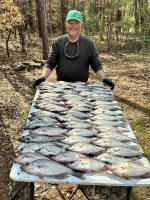
During the winter months of November, December and January, the fish move back out into open water. Nelms recommends using a LiveScope to find the fish in winter months and casting to them.
“During that time, you won’t see the big schools, but you’ll see two or three in a group and, on a good day, you can chase them,” said Nelms. “We’ve chased fish 50 to 100 yards just staying behind them. They’ll swim away, and we just stay on them and pick them off. That’s when we start seeing our real big fish.”
Nelms says winter months don’t bring in as many fish, but he prefers those because they can deliver crappie up to 2-1/2 pounds. Catching 15-20 fish is a good day in the winter, whereas summer anglers can have 100 fish days between May and September.
The best live bait to use for Oconee’s crappie are native threadfin shad.
As for line Nelms recommends using 2-, 4- or, at most, a 6-pound-test line. When fishing in brushpiles, he recommends using 10-pound braid with a half-ounce trolling sinker and a 16-inch leader of 4- or 6-pound fluorocarbon.
“If we get hung up, we can snap that, and we don’t lose the weight. It’ll just break the leader off, and then we can re-tie a leader fast,” said Nelms.
Nelms says fishing in Lake Oconee is comparable to other big lake destinations, like Lake Blackshear in Georgia and Crescent Lake in Florida, giving crappie anglers a new location to try anytime of the year.
(Anietra Hamper is a career television news anchor and investigative journalist turned award-winning outdoor writer specializing in fishing and outdoor adventure. Anietra travels the world fishing for catfish and other unique species in new destinations.)
