

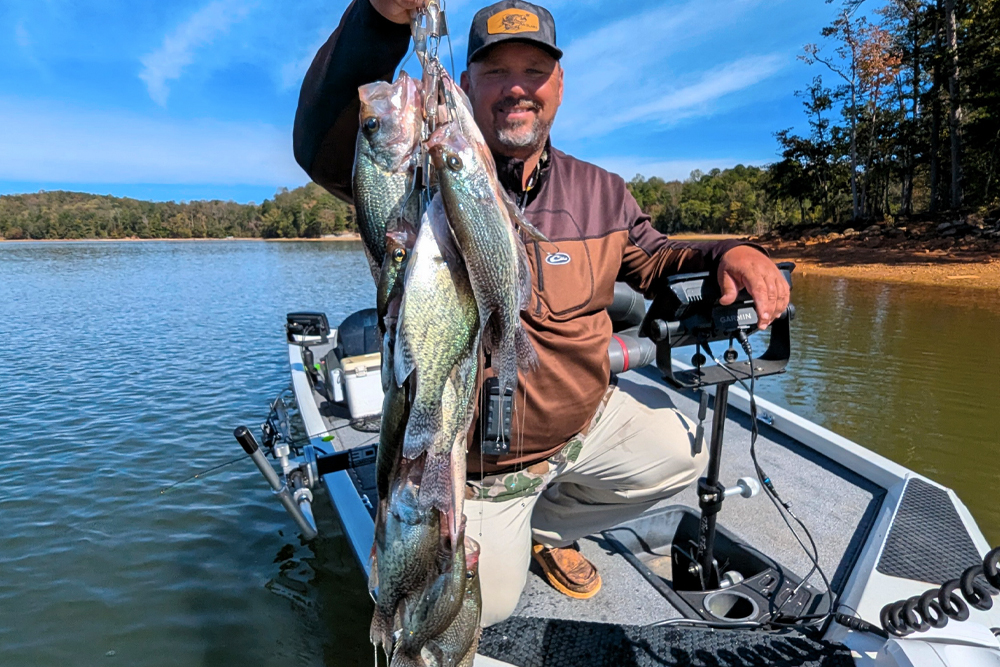
Capt. Rodney Donald relies on FFS to find big schools of crappie
quickly on Lake Hartwell, an overlooked crappie-fishing treasure.
Lake Hartwell: An Overlooked Crappie Destination
Story and photos by Terry Madewell
Lake Hartwell, a deep, clear lake in the upstate portion of South Carolina, has earned a reputation as a premier striped bass fishery, and has hosted four Bassmaster Classics in recent years. But crappie anglers are discovering that fishing for their favorite target is an overlooked opportunity at Lake Hartwell.
Capt. Rodney Donald (864-356-0143) is a professional crappie-fishing guide on Lake Hartwell, and he has mastered the art of crappie-catching on this lake.
“The fishing is productive year-round,” Donald said. “But the best time to consistently catch limits, with plenty of slabs in the creel, is from February through June. Knowing how the seasonal patterns impact the bite is crucial.”
The 48-year-old Donald is a lifelong resident of Fair Play, South Carolina near the lake, and he’s fished the lake his entire life.
“I learned a lot of my basic, old-school fishing strategy from my grandpa, when I was young,” he said.
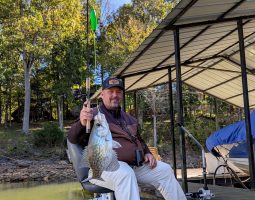
His fishing strategy now leans heavily on electronics, but even before Forward Facing Sonar (FFS), he used traditional electronics to consistently find and catch crappie.
“With the FFS, I can find schools of crappie quicker,” he said. “That’s an asset because I’ve learned that this lake holds many potential targets to congregate crappie in significant numbers. It’s common throughout the winter and spring to find vast schools of crappie throughout the lake.
“The key is locating those areas daily, and the specific depths to fish, because many good-looking spots hold fish for a short time, and then the crappie move,” he said. “It’s an ever-changing pattern.”
The primary seasonal patterns that Donald finds successful relate to woody cover and shade.
“Natural woody cover exists in the lake, and I certainly work those areas, but I also place a lot of my own brushpiles in various depths of water,” he said. “That enables me to target fish anytime, regardless of depth preference. Also, shade is a major attractant because Lake Hartwell is so clear, and crappie often orient to the shade provided by docks. While brush or woody cover around the docks is excellent, docks without woody cover are potential crappie magnets solely because of the shade.”
At this time of year, in February and into early March, he said crappie are orienting to docks at depths of 15-20 feet, and many fish can be congregated in small areas.
“By early to mid-March, some crappie are still relating to docks, but many are beginning to migrate into the creeks, often roaming in big schools,” Donald said. “I’ll find them around the ledges and channels, and they may be 10-15 feet one day, but 20 feet the next. That’s where FFS helps with the daily pattern.”
When the fish move shallow to spawn, Donald said they’ll get into six to eight feet of water on shallow flats. This spawning pattern is only dependable for a couple of weeks, and timing varies each year, based on water temperature.
“During April and May, crappie are consistently found on brush at various depths, from shallow water down to 15-20 feet deep,” he said.
During summer and fall, fish are found throughout the lake, and shade and woody cover are prime targets. The typically clear summertime water-color pattern keeps the fish deep or shade-oriented.
Donald’s favorite pattern year-round is using FFS to find crappie, and then targeting them one of two ways.
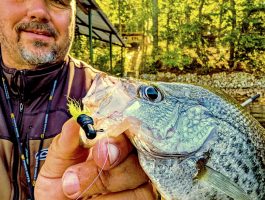
“My preferred method is to cast 1/16-ounce jigs, counting them down to the depth fish are marked,” he said. “I use a lot of Bobby Garland grubs, and the monkey milk color pattern is a favorite. But I also use hair jigs at times, and on some days, they’ll prefer a specific size and profile, so even when I see them on the FFS, I’ll refine my presentation.”
When using jigs, Donald advised anglers to cast beyond the brush and school of fish and allow the lure to sink, watching it on the FFS. Once it reaches the depth of the top of the crappie, start reeling slowly, twitching the rod, and keep the lure at the top of the school of fish.
“The sonar shows the fish in real-time, and if a crappie follows the jig, reel slowly and be patient,” he said. “If that doesn’t work, twitch it away from the fish quickly, then stop; often a slab crappie can’t allow it to get away and inhales the lure.”
Live minnows are part of Donald’s daily strategy, and if crappie are finicky, he works the area with live minnows using slip-float rigs.
“This is a deadly tactic even on tough days,” he said. “We’ll set the depth the fish are holding, and rig the float depth to be just above the fish. Cast it beyond the target and slowly work the live minnow back right over the top of the fish.”
Capt. Rodney Donald can be reached by phone at 864-356-0143, or check out his Facebook Page at Lake Hartwell Crappie Experience.
(Terry Madewell of Ridgeway, S.C., has been an outdoor communicator for nearly 50 years. He holds a degree in Wildlife and Fisheries Management and has a long career as a professional wildlife biologist/natural resources manager. He’s passionate about sharing outdoor adventures with others.)
More Fishing Opportunities and Fun
The complete Lake Hartwell fishing experience can be more than just great crappie fishing. Family-friendly fishing guides are available for striped bass trips by calling Capt. Cefus McRae, 404-402-8329, or Chip Hamilton at 864-304-9011. Hamilton also offers a fantastic family fishing adventure during the winter, targeting spotted bass on nearby Lake Keowee.
Visitors to the area can do much more as individuals or family groups by checking out the Lake Hartwell Country Tourism website at https://www.lakehartwellcountry.com/ and following the provided links for accommodations, dining, local attractions and much more. Visit the Lake Hartwell Country Tourism office at 120 History Lane, Pendleton, SC, for specific information, and enjoy the historic Agriculture Museum at that location as well. Call 864-646-3782 for specific details.
(Terry Madewell of Ridgeway, S.C., has been an outdoor communicator for nearly 50 years. He holds a degree in Wildlife and Fisheries Management and has a long career as a professional wildlife biologist/natural resources manager. He’s passionate about sharing outdoor adventures with others.)
