

Paddlin’ with Madalyn: Setup for Successful Springtime Slab-Hunting
Story and photo by Madalyn Roberts
If you’re a fisherman finding yourself on the fence about that kayak purchase, take this as your sign. For several years now, I’ve truly enjoyed every minute of crappie fishing out of my Nucanoe in all seasons, but most especially the springtime.
When I first began my kayak journey well over a decade ago, I was paddling creeks exclusively in a recreational sit-in kayak. What’s always captivated me about the experience of kayaking is the feeling of peace and tranquility brought forward by simply getting out in nature and being on the water. In the beginning, I was just a gal and her kayak, flowing down the creek with the current, chasing the day’s adventure.
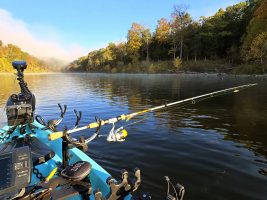
When I’m out in my kayak nowadays, generally I can be found crappie fishing on a lake somewhere, which—when taking boat traffic into consideration—doesn’t quite give off the same feeling of peaceful solitude as does a creek or river. That’s why springtime crappie fishing is the most exciting for me, because when you travel back into those creeks, you’re getting the best of both worlds—a lesson from Mother Nature in slowing down and appreciating your surroundings, while simultaneously setting yourself up in the strike zone for spring’s spawning crappie.
When its time to start targeting crappie in shallower water from a kayak, there are really only two rigs I use consistently, either of which can be fished with a slip float. The B’n’M 75 Series Combo is my go-to all-purpose rod, and it becomes a truly deadly weapon when you add a P.B.S. 18 balsa float by Stan’s Slip Bobbers to the line. Between the metal grommets on either end ensuring continuous movement over the line and the contrasting black and white line through the center of the float making spotting a strike easier, Stan’s Slip Bobbers are the most well-thought-out bobber on the market.
My favorite feature is that the weight recommendation is written directly on the balsa float. For example, the P.B.S. 18 is meant to be fished with weight up to 1/8 ounce. This makes the balsa float super user-friendly because if you’re following the recommended weight and the float never stands upright after the pitch, that’s the indicator to add more weight underneath. Or alternately, switch to a slip float meant for lighter jigs.
Lighter weight slip bobbers like the Mini Mag (paired with 1/16-ounce jig), Mini (paired with 1/32-ounce jig) and the Mini Mini (paired with 1/64-ounce jig) are all a real tactical treat for dock shooting, or shooting under low-hanging trees in creeks, keeping the bait in the strike zone just a little longer on the retrieve. When I’m using these smaller floats, it’s on what has quickly become my favorite ultralight B’n’M rod, Leland’s TCB.
The best part about fishing for crappie in the springtime is you don’t need a kayak with all the bells and whistles. The plan is to find shallow water, and the most basic kayak is more than sufficient for the task. With the right mindset, you’ll have a day on the water to remember, whether you catch crappie or not.
(Madalyn Roberts is from Kansas City, Missouri although she considers herself a southern transplant, having lived in Kentucky for 16 years. She serves her Louisville community by working for a nonprofit organization facilitating free home repairs for elderly and disabled homeowners. In her spare time, she enjoys being in the outdoors in all capacities, most especially fishing, hiking and camping.)
