

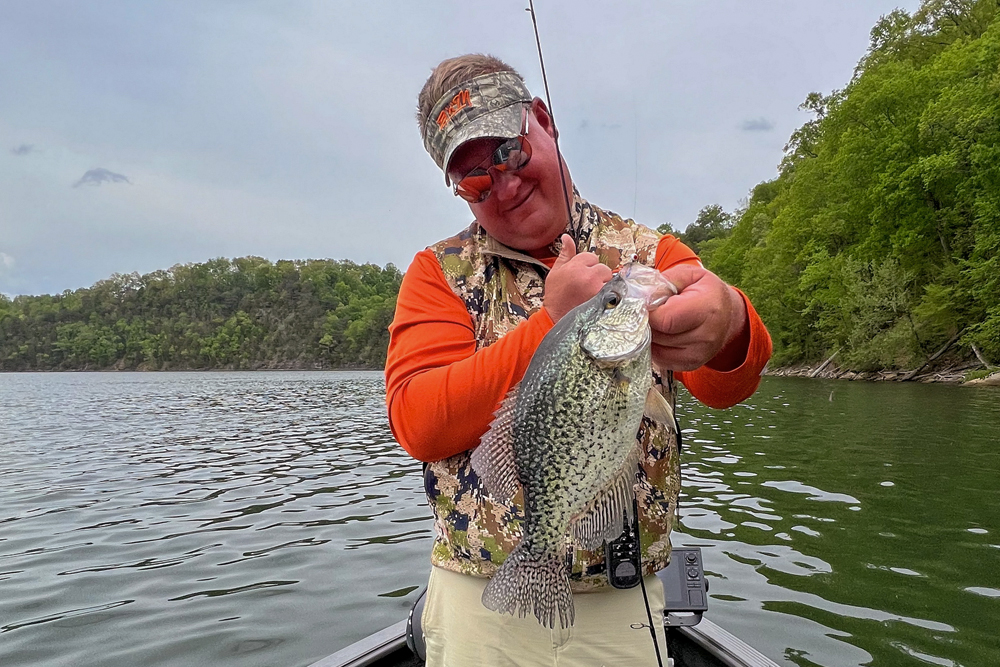
Dale Hollow guide Corey Thomas finds crappie in submerged trees and brushpiles.
He stays back from the cover, uses a lightweight hair jig and lets the jig fall to just
above the cover before starting his slow retrieve. He says it can be a year-round
tactic by concentrating on cover at the right depth for the season.
Cheat Sheet for Year-Round Crappie
Story and photos by Tim Huffman
Fishermen want a guideline that guarantees the right spot, depth and bait to catch crappie during any season. Unfortunately, no foolproof guidelines exist. However, experts’ tips and experience can provide a “cheat sheet” for seasonal fishing to help improve your odds for putting more crappie in your boat.
Spring is divided into three phases: prespawn, spawn and postspawn. Fish movements and fishing tactics are very different in each phase.
Prespawn. Ronnie Capps, eight-time national champ, says, “Prespawn crappie are stable and can be caught. The female fish are full of eggs and heavier than any other time of the year. They are predictable, hungry and will cooperate. However, when water warms to the upper 50s, crappie become unstable and more difficult to find and catch.”
Spawn. Dan Dannenmueller, tournament fisherman, says, “Crappie will start moving from holding areas to shallow water when the water reaches the mid-50s. Males come in first to prepare beds. Females eventually come in for what I call ‘bombing runs’ to lay eggs. The female will make repeated trips to lay eggs with different males. Usually, the spawn ends from the mid-60s to low 70s.”
Another tip comes from crappie pro Wally Marshall. “For spawning fish, check water temperature,” he says. “Make sure you are getting at least 59- to 60-degree water. For example, several years ago, my partner and I went into the back of a cove that had warmed water. We caught 35 crappie in 45 minutes. Temperature is the key to being successful in the spring.”
Postspawn. Fish are recovering from the spawn. Post-spawn can last for a while because not all fish spawn at the same time. Post-spawn fish patterns are usually predictable. Crappie are sometimes sluggish, but they can be caught. Look for crappie to be suspended in flats and over mid-depth drops.
Spring fishing can involve a variety of techniques. Vertical jigging and slow trolling are still popular, with forward-facing sonar being the new tool for finding and catching. Post-spawn includes warmer water so fishing can also include trolling jigs or crankbaits.
Summer. “The water is hot,” says three-time classic champ Travis Bunting. “It depends upon the lake, but fish will go shallower if they have a lot of shallow water. Shad will be on top of the water because oxygen levels are better. Surface agitation causes oxygen levels to increase. Another factor later in summer is a thermocline. Timber lakes like Truman have extremely shallow thermoclines. Reservoir crappie may be anywhere from one foot under the surface down to 20 feet deep, but it’s not difficult to pattern them.”
Corey Thomas, professional guide, Dale Hollow, (270-566-1152) says, “You better get out by daylight. If you’re doing it right, you can have a limit by 11 or 12 o’clock. If you wait any later, the wake boats will eat you up.”
Russ Bailey, Brushpile Fishing TV host and Legends of the Outdoors Hall of Fame member, says, “I love July because the spawn is over and crappie are in a solid summer pattern. We don’t have a lot of weather fronts. In Ohio where I live, the fish are under the pontoon boats for the shade. Fish are super aggressive. On sunny days, I shoot jigs as far underneath as I can get. I want the darkest, shadiest area I can find.”
Baily continues, “We’ve pulled crankbaits on Grenada in the early-morning summer heat and caught limits of crappie in two hours. Totally different fishing was when I was at Dale Hollow with Corey Thomas in August. We caught fish in 40 feet of water using a slip float, small split shot and minnow. The bait had to be right in the brushpile and bites were subtle. So, techniques must match the lake type and situation, but summer fishing can be very exciting and fun.”
Fall crappie are transitioning from summer to fall and then fall to winter.
Travis Bunting says, “Fall can be tricky because fish are on the move. They don’t stay in a pattern. But when temperatures get down into the 60s, everything changes. You can fish them almost like its springtime, in the same areas, like a false spawn. Slow trolling, casting and other techniques work in the fall.”
Many pros say an early fall tip is to target scattered crappie. These fish are likely chasing shad, so pulling crankbaits is a top technique. Trolling crankbaits allows covering a lot of water to find the most active bite. Favorite baits include Bandit 300 series and Pico INT.
Corey Thomas has tips for fall. “It goes against everything I’ve been told, but I look for gar,” he says. “The gar are feeding on bait, and crappie are around feeding on the same bait. It works.
“As we transition later into the fall,” Thomas continues, “it’s more about deep flats next to river channels. High-tech electronics work, but a simple locator and paper map work, too. Find a river swing out in the middle of the lake on the edge of a flat with cover near the drop and you’ll find fish.”
Winter fishing starts when water temperatures get to around 45 degrees. Fish are less aggressive, so be patient. Crappie still eat, so it’s not uncommon to have some very good catches. It’s likely winter fish will be in the same spots where they were found in the summer.
B’n’M pro staffer Kevin McCarley says, “Fish location depends upon the type of water being fished. In some lakes fish are deep. My home lake is Wheeler, Alabama. I do better by going shallow in the winter. The fish love the 3- to 4-foot water with stump flats. The key is to have a deep channel where they can hold but then move up on the shallow stump flat to feed when it warms up a little.”
Temperature Guidelines
45-57: Prespawn. Fish are in 7- to 12-foot-deep holding areas near spawning banks. Crappie are heavy, fat and actively feeding. Slow tactics and forward-facing sonar are popular.
57-65: Peak spawning, shallower lakes. Male fish go in, make beds and lure females in to lay eggs. The male fertilizes the eggs and guards the nest. Jigging, chasing with forward-facing sonar and tossing slip-floats are good techniques.
65-72: Peak spawning, large reservoirs. Large deep-water lakes will have slow warming water, so fish may spawn later and deeper than in shallow lakes.
70s: Postspawn crappie suspend in 10-20-feet-deep water. Pulling jigs or crankbaits are good methods. So is slow trolling. Forward-facing sonar is a good technique. Look at drops, creek channels and long flats.
>75: Summer. Heat and pleasure boaters are summer challenges, but crappie are active. Most techniques work, with fish in both shallow and deep water. Fast trolling tactics, jigging and casting are good technique choices.
70-50: Fall crappie are on the move, so you may need to search for them. Baitfish schools can be critical for success. When baitfish schools and crappie are found, action will be good. A variety of tactics work during the fall.
<50: Winter fish are transitioning toward deep water early in the season. As water cools, most fish can be found on deep ledge brushpiles and stumps. However, crappie will sometimes follow baitfish into shallow water that warms. Try small 1.5-inch jigs or small minnows. Also consider ultralight tactics and tackle.
A “cheat sheet” is good for a guideline to fishing all the seasons. Good tips from pros can lead to better fishing. However, crappie don’t always follow the rules, so be open-minded when looking for crappie.
(CrappieNOW senior writer and Fresh Water Fishing Hall of Fame member, Tim Huffman, has several books, including his newest, Papermouth, Modern Fishing Techniques, available in Kindle or paperback on Amazon, or from his website, www.monstercrappie.com.)
