

Paddlin’ with Madalyn—The Importance of Using a Kayak Safety Checklist
Photos and Story By Madalyn Roberts
I’ve been crappie fishing out of my NuCanoe Frontier 12 kayak for several seasons now, and while I wish I could proclaim every trip out on the water goes off without a hitch, that would be a far cry from the truth.
What I can say, however, is each adventure is a learning opportunity, and many of the lessons having nothing to do with the actual fish. Thankfully thus far, I haven’t had many trips out in which I felt my safety was at risk. However, I recently learned a lesson on the water I want to share so others can learn from my mistake—one that demonstrates the importance of utilizing a kayak safety checklist.
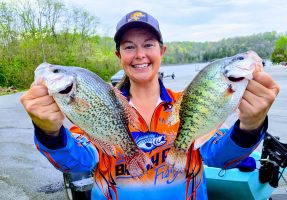
Mid-April, I made a trip out to Taylorsville Lake to get in some crappie fishing during the spawn in Kentucky. I had no plans to venture far from the creek coves, so I selected a ramp that had a cove on either side nearby. I spent the better part of the morning and early afternoon fishing the bigger of the two coves with moderate success. I noticed the wind picked up as the day wore on; however, up to this point, I had no issues.
Then, I proceeded to jog over to the other nearby cove, battling the wind and the waves the entire way. I have learned how to position the kayak against the waves to make a minimal splash inside the kayak, so I was surprised after I arrived at the cove, got myself a drink out of the cooler behind me and looked down to see a substantial amount of water at my feet—enough to make me nervously reconsider my decision to relocate.
At that point, I wasn’t sure why I was taking on so much water, but I wanted to be close to the shore in the event I needed to pull up on the bank to sort things out. So, I trolled back over to the bigger cove having shallow banks, which provided minimal but improved cover from the wind. I, then, used my microfiber towel to slowly wring out the water which had accumulated at my feet. However, when the issue persisted and I found myself repeating this process several more times that afternoon, it made me re-evaluate the situation.
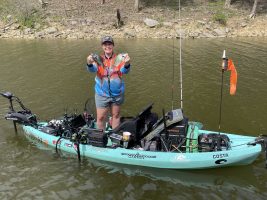
Turns out, my scupper plugs had been pulled from their rightful home and not replaced. Every time I stood up to reach behind my seat into the cooler, I took on water. I almost never remove the plugs, except for the rare occasion when I clean my deck. Because my cooler is positioned between my battery box and black pac directly over where the only holes are located, I didn’t realize they were missing.
When I arrived home, I discovered my hull was filled with water.
Although I had considered the situation to be handled at surface level, the hull had slowly been filling with water all afternoon. Had I spent much more time on the water, I would not have ended the day smiling proudly with two nice Taylorsville crappie.
Nowadays, this is the checklist I use to make sure my trips out on the water are both safe and successful.
KAYAK SAFETY CHECKLIST:
- Properly fitting Personal Flotation Device (PFD)
- Water Temperature Appropriate Clothing
- Proper Footwear
- Paddle
- Manual Bilge Pump
- Whistle
- Air Horn
- Flag
- Navigation Light
- Compass and Map or Chart
- Communication Device
- VHF radio or GPS locator
- Scupper Plugs
- Microfiber Cloth
- First Aid Kit with Matches
- Duct Tape
- Knife
- Rescue Gear
- Drybag with an extra clothes
- Drinking Water, Snacks, Hydration Packets
- Sun Protection
BEFORE YOU LEAVE:
- Check the weather.
- File a float plan (tell someone where you’re going and when you plan to return).
- Inspect your equipment
- Know your limits
Author’s note: Kayak drainage varies depending on the model, as does the number of scupper plug holes. One important variable here is what type of water the kayak will be floating in, i.e. if there are rapids or big waves to take into consideration. I keep my scupper plugs in because the NuCanoe Frontier 12 only has two drain holes toward the back of the kayak and I carry a lot of equipment that weighs it down. And because I mainly fish in lakes, I don’t have to worry about rapids or big ocean waves.
(Madalyn Roberts is from Kansas City, Missouri although she considers herself a southern transplant, having lived in Kentucky for 17 years. She serves her Louisville community by working for a non-profit organization facilitating free home repairs for elderly and disabled homeowners. In her spare time, she enjoys being in the outdoors in all capacities, most especially fishing, hiking and camping.)
