

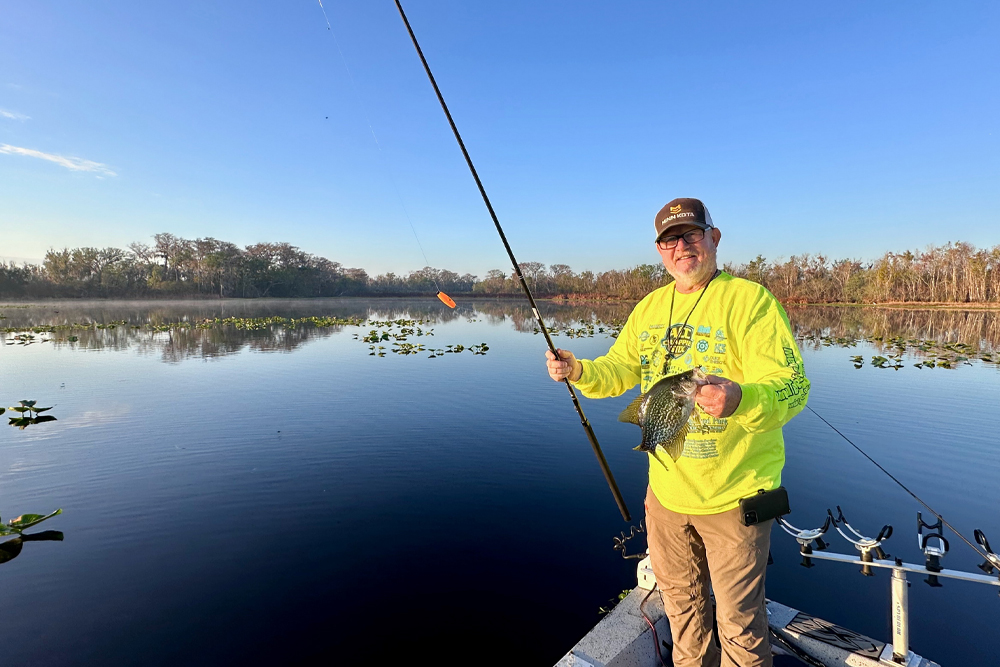
Crappie angler Donnie McCormick taking advantage of the morning bite on
the St. Johns River tributaries in Florida. Photo credit: Anietra Hamper
The St. Johns River: A Habitat Haven for Crappie
By Anietra Hamper
The St. Johns River and its tributaries in east-central Florida hold some of the best crappie fishing in the United States. The river flows for more than 310 miles with varied habitat, topography and currents. Some of the river’s best crappie fishing waters are in West Volusia County between Orlando and Daytona Beach.
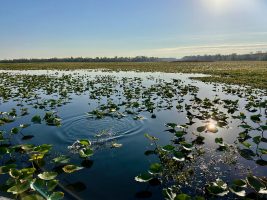
Photo credit: Anietra Hamper
Known locally as “specks,” these fish thrive here thanks to abundant habitats, slow-moving currents and a web of spring-fed tributaries. This unique balance of ecosystem and adaptability on the St. Johns River is what gives crappie anglers dynamic fishing opportunities.
We set out for a day of fishing with crappie expert Donnie McCormick of DeLand, Florida, who grew up on these waters, hoping to find out for ourselves what makes this fishery stand out to anglers.
A Complete Ecosystem for Crappie
At its core, the St. Johns River offers everything crappie need to survive and flourish, starting with habitat diversity. Submerged vegetation, lily pads and natural brush create layers of structure that provide crappie cover and feeding grounds.
“You’ve got everything that a crappie needs,” says McCormick, owner and fishing guide for 5 M Outdoors. “You’ve got the structure. You’ve got the bait. You’ve got the ecosystem.”
Beneath the surface, that ecosystem is constantly working, with grass shrimp thriving in aquatic vegetation and serving as a steady food source for crappie year-round. In the spring, schools of threadfin shad move through the system, providing a high-protein food source that fuels increased growth and more aggressive feeding.
“They’ll eat a crayfish. They’ll eat anything,” McCormick says. “The other day I caught one, and it had one of those armor-plated catfish in its throat.”
This abundance of forage means crappie in the St. Johns River are not only plentiful but often healthy and sizable as evidenced by some our catches during the day that ranged upwards of 2 pounds consistently. Combined with Florida’s warm climate, the river supports a fishery that doesn’t shut down after a short seasonal window.
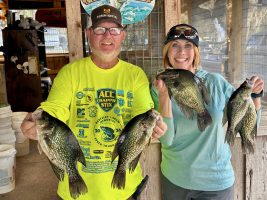
Photo credit: Ian Henderson
River Characteristics Create Opportunity
Beyond habitat, the physical nature of the St. Johns River plays a major role in its appeal. McCormick says that unlike faster, more turbulent systems, this river flows slowly, with a gentle slope that creates a range of fishable conditions.
This flexibility allows anglers to adapt to seasonal changes without leaving the system. Cooler months bring fish into shallower cover, while summer pushes them into deeper structure.
“You can catch a crappie in eight inches of water, but when it gets hot, you just go to deeper water,” McCormick says.
The slow current also makes it easier to present baits naturally, whether drifting, trolling or jigging.
The fresh water from numerous tributaries and springs is equally important to stabilize water quality and temperature, even during fluctuating weather conditions.
“You’ve got all these tributaries pushing this fresh water in here,” McCormick says.
He says this constant renewal supports not just crappie, but an entire food chain that keeps the system thriving.
A Network Beyond the Main River
The St. Johns River is an interconnected network of creeks, springs and lakes that expand angling opportunities. In West Volusia County alone, anglers can explore a variety of environments, each with its own character.
From clear spring runs to darker, vegetation-rich backwaters, these connected systems allow anglers to adjust based on conditions and fish behavior. During certain times of year, the mouths of spring-fed creeks can become hotspots holding concentrations of bait and drawing in feeding crappie.
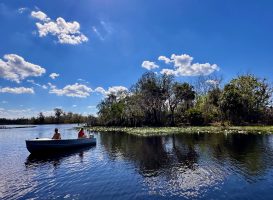
The diversity also makes the area appealing for multi-species anglers, though McCormick remains firmly committed to specks.
“This is all I fish for because I enjoy it so much,” he says.
Techniques for Every Angler
One of the defining features of the St. Johns River crappie fishery is its versatility. The river’s structure and fish behavior allow for a wide range of techniques, making it accessible to beginners and appealing for seasoned anglers.
For simplicity, McCormick says that few methods beat the classic cork-and-jig setup. This is what we are using today to target the early morning fish sheltering beneath lily pads.
“That is as simple of fishing as you can get,” McCormick says. “A light line, a small float and a jig placed near cover can produce consistent bites, especially in shallow or moderately deep water.”
Vertical jigging is another effective approach, particularly around dense vegetation. McCormick suggests easing a boat into cover and dropping a jig into openings where anglers can target fish holding tight to shade and structure.
“These fish are very sunlight sensitive,” McCormick says. “They’ll be under that cover during this time of the day,” referring to midday.
Trolling, often with “pulling” or “pushing,” is one of the most efficient ways to cover water.
“For a novice, trolling is your best bet,” McCormick says. He recommends moving baits slowly at controlled speeds so anglers can locate schools of suspended crappie and dial in productive depths.
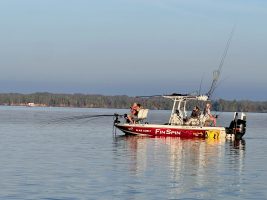
Photo credit: Anietra Hamper
Our bait of choice today is plastics, but live bait, particularly minnows, is also preferred. When paired with specialized rigs like a weighted moon jig, McCormick says minnows can be presented naturally at precise depths. But he advises a subtle approach.
“You want a small profile,” McCormick says. “Too big of a profile turns them off.”
Anglers can also opt for night crappie fishing easily on this river system. Using submerged green lights, anglers can attract baitfish, which in turn draw crappie into the illuminated area.
“You’ll see the bait come up around the light beam,” McCormick says. “Then you’re going to start catching fish usually 10 to 12 feet below that.”
A Fishery Worth Exploring
The St. Johns River is a dependable fishery because it offers a rare combination where natural habitat, consistent forage and adaptable conditions exist in one place.
A great way for new crappie anglers to try the St. Johns River is by participating in the annual Berkeley Labaw Memorial Crappie Tournament organized by McCormick and held each January for anglers of all skill levels.
Whether its drifting jigs along vegetation lines, trolling open channels or dropping minnows into shaded cover, anglers have countless ways to connect with crappie on this river system, which translates into opportunity all year long.
(Anietra Hamper is a career television news anchor and investigative journalist turned award-winning outdoor writer specializing in fishing and outdoor adventure. Anietra travels the world fishing for catfish and other unique species in new destinations.)
