

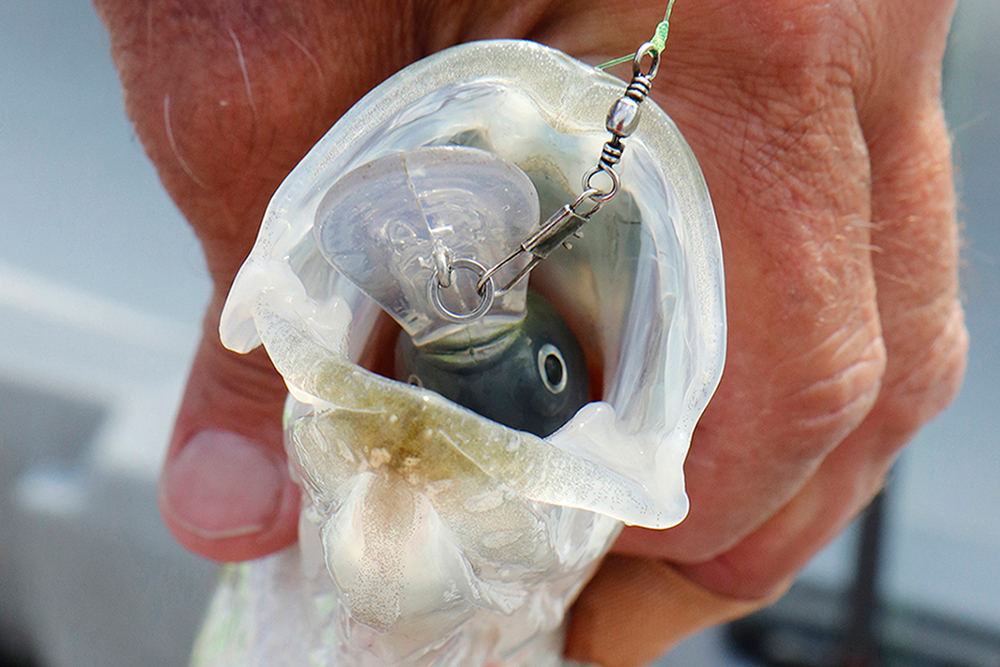
Bad, but good! The bad is getting a crankbait out, but the good news is a fisherman
knows he has everything dialed in just right when crappie are swallowing the bait.
Summer Crankbait Fishing—It’s HOT!
Story and photos by Tim Huffman
Summer provides excellent opportunities to chase crappie with crankbaits. Trolling allows a lot of water to be covered. When baits are properly presented, it’s the best way to find groups of active fish. The following tips give great ways a fishermen can put more fish into the livewell.
Use the Precision Trolling App
Kentucky Lake guide Doug Wynn is an expert at pulling crankbaits. He says, “Running baits at the right depth is important. I’m looking for structure, and I’m known for putting crankbaits in harm’s way. So, I go through several hundred a year. My goal is to get the baits close to structure but not in it. I religiously use the Precision Trolling App to get my baits to the right depth. This app gives the depth of a bait upon my specific crankbait, line size and amount of line out.”
Use Planer Boards
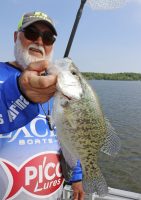
Wynn says “I’ve used forward-facing sonar just to watch fish in front of the boat. It’s common to watch them move to the side away from the boat. That’s ideal when using planer boards because they intercept those fish. There’s no doubt we’ve educated the fish because they are quicker to run from trolling motor and transducer noises. A boat must sound like a nuclear submarine coming at them. The planer boards get the baits out to the side away from the boat where crappie go when spooked by the boat.”
Off Shore Planer Board owner and expert fisherman Nick Deshano says, “Learning to pull planer boards takes a little time. Start out fishing one board on each side until you get comfortable setting them out and catching fish. Then, add another pair of boards. Add another after mastering what you are using. I’m experienced. So, I’m comfortable fishing five or six pair.”
The Right Crankbaits
Wynn says, “I like long crankbaits. I’m targeting 16-inch-long slabs, not nine-inch crappie. My go-to is a Pico INT, and I’ve caught a lot of big crappie on it.”
“Color is important,” says Wynn. “The baits have action, but a fast-moving bait forces a fish to make a split-second decision to hit it or not. So, they need to be able to see it. I believe the right color creates the right shadow they can see. Therefore, color is key.”
A few of the top crankbait choices include Bandit 200 and 300 series, Pico INT and Squarebill, and Flicker Shads.
Find the Right Locations
“I’m looking for drop-offs, often in the mouth of a bay,” says Wynn. “I want to find the deeper humps or drop-offs, or big flats next to deep water. Depths of 12 to 15 feet are common at Kentucky Lake. I don’t care if it’s a traditional place to catch fish. I’m looking for shad balls.”
Kent Driscoll, B’n’M pro staff manager, says, “Here in Mississippi, it’s usually deep flats in the 20- to 30-foot range, with summer fish at the thermocline 13 to 16 feet down. They are chasing shad.”
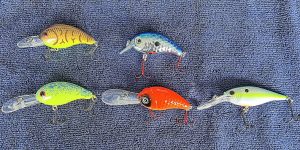
“Don’t forget to check for shallow crappie,” says James Calloway with the Southern Arkansas Crappie Club. “They can be in shallow water, or they can be in deep water but suspended up shallow. I like using a shallow-running Pico Squarebill with a 1/8-ounce jig above the crankbait. It provides two bait choices, and the jig helps get the bait a little deeper.”
Northern crappie expert and YouTube content creator Nick Linder says, “Northern crappie will likely be on a weedline in eight to 23 feet of water. When crappie are on the outside of the weedlines, you can troll small cranks like a Northland Bumble Bee. We often troll the same way for walleyes. The key is to identify the crappie and figure out if you can pull crankbaits to catch them.”
Boat Control
Most experts agree that 1.5 to 1.8 mph is usually the ideal speed range, with 2.2 mph being the maximum trolling speed for crappie.
Driscoll says, “When fish aren’t hitting, I’ll do what’s called wildcatting. Instead of trolling in a straight line, I’ll turn my boat back and forth, left and right. It gives a direction and speed change to the baits. Also, I’ll turn my trolling motor off for several seconds to quickly vary speeds. Baits doing something erratic can trigger strikes.”
A problem for longline trollers is turning because lines can cross and cause tangles. Make long, slow turns. If needed, you can shorten line lengths until the turn is finished.
Other Tips
If a crankbait doesn’t have red hooks, consider adding them. Most experts agree the red hooks draw more strikes.
Power trolling crankbaits out the front of the boat requires beefy poles, line, weights and baits. It’s a great way to present baits to crappie before they spook. Power trolling makes setting bait depth much easier than when long lining. It also has the advantage of quick turns in the water, unlike longlining. The biggest disadvantage is it requires strong arms and hands to wrestle a fighting fish and 3-ounce weight in the current of a moving boat and out on a 16-foot-long pole. It makes landing difficult. However, the technique is incredibly efficient.
Our final tip is from our CrappieNOW publisher Dan Dannenmueller. He says, “No matter which bait or technique you use, it’s important to run baits just above the fish. The Precision Trolling Data App provides data for setting bait depths whether using cranks or jigs.”
Closing
Trolling crankbaits is very relaxing and fun. Any technique requires work, but crankbaits are a good way to cover a lot of water, target open-water crappie and enjoy a relaxed style of fishing.
(CrappieNOW senior writer Tim Huffman is a member of the Fresh Water Fishing Hall of Fame and Legends of the Outdoors Hall of Fame. Huffman has several books, including Papermouth, Modern Fishing Techniques, available in Kindle or paperback on Amazon, or from his website, www.monstercrappie.com.)
