

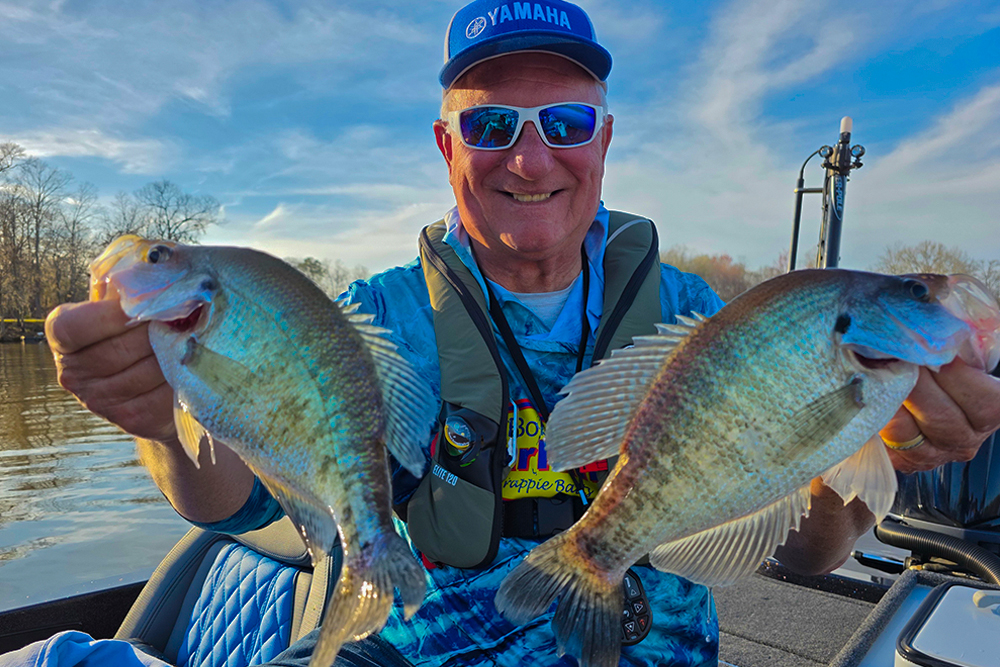
Crappie Dan shows two great crappie catches after a day on the water.
Myth Busting: Old-School Crappie Tactics That Still Work
By Anietra Hamper
Photos courtesy of Dan Dannenmueller
For Dan Dannenmueller Sr., better known across the fishing world as “Crappie Dan,” his success with crappie fishing isn’t because of forward-facing sonar or expensive gear. It’s from foundational knowledge that he’s developed over a lifetime.
“I learned to fish with cane poles and nylon line,” said Dannenmueller recalling his childhood. “We fished for everything and ate everything.”
Backwaters, swamps and shallow cypress lakes shaped his early instincts, which became the foundational knowledge from which everything else was built. Those formative years of fishing were about observation, adaptation and putting food on the table.
After a professional bass fishing career and service as an Air Force officer, Dannenmueller transitioned into competitive crappie fishing in 2008. He became a consistent tournament presence and later launched CrappieNOW magazine in 2015. Today, he still fishes competitively, often alongside his wife, Sue. But his philosophy and tactics haven’t drifted far from those early days.
“People think they need everything,” he says. “You don’t. The basics still work.”
While Crappie Dan has the best tools of the trade today on his boat, he still relies on old-school knowledge and techniques as the foundation of his expertise. He breaks down some of the most common myths that anglers have when it comes to crappie fishing.
Myth #1: You Need Expensive Gear to Catch Crappie
The aisles at tackle shops are filled with modern fishing gear with rows of specialized rods, hyper-realistic plastics and tech-driven accessories. The options are overwhelming, but according to Dannenmueller, the most effective setup is the simplest.
“A basic setup with a cork. That’s one of the most basic things I learned,” he says.
A single pole, a small slip cork or clip-on bobber, a hook and live bait of minnows, worms or even crickets can produce consistent results, according to Dannenmueller.
Slip bobbers remain a timeless innovation that allow anglers to adjust depth easily without sacrificing casting distance. For beginners or families, Dannenmueller suggests keeping things simple with inexpensive panfish kits that are an easy entry point.
“You can get a setup for less than $100. The common user just wants to catch fish and eat them,” he says.
Old-school doesn’t mean outdated. It means efficient.
Myth #2: Spider Rigging Is Too Complicated
Spider rigging might look intimidating with multiple rods fanned out across a boat, but its origins are anything but modern. The technique dates to crappie-thon tournament fishing in the 1960s and ’70s.
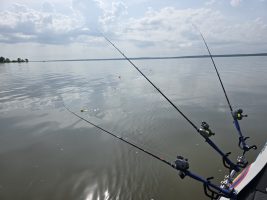
At its core, spider rigging is simple. It uses slow trolling with multiple long rods to cover water and present bait at controlled depths.
For beginners, Dannenmueller recommends starting small with one or two rods, then build up as you learn the technique. Spider rigging is still effective because it’s scalable for anglers to cover more water whether they’re using two rods or eight.
“You don’t have to have any electronics,” Dannenmueller says. “Just follow the bank. Imagine what it looks like under the water. You’re not out there to find the biggest fish. You just want to have fun.”
Myth #3: Technology Replaces Basic Knowledge
If there’s one myth Dannenmueller pushes back on hardest, it’s the idea that electronics replace fundamental understanding.
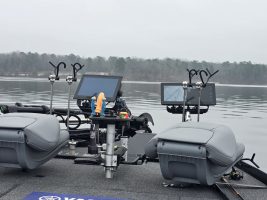
Before sonar, anglers relied on printed maps, visual landmarks and intuition. Dannenmueller says those tools still matter because understanding seasonal movement, water depth and structure is foundational for finding fish.
“We didn’t have all that back in the day,” he says. “If I knew the depth and the time of year, I knew where they’d be.”
Today, apps, castable depthfinders and basic sonar units can supplement that knowledge, but they don’t replace it.
Even something as simple as triangulating landmarks can put you back on productive water if you don’t have GPS available.
Myth #4: Crappie Always Go Deep in Warm Weather
This is one of the most persistent misconceptions in crappie fishing and one Dannenmueller quickly dismisses.
“That’s a myth. It isn’t true,” he says. “Biologists have shocked up 2-pounders in four or five feet of water in 90-degree heat,” he says. “The fish had everything they needed. They didn’t care if it was hot.”
While many crappie do move deeper in warm conditions, others remain shallow if the environment with shade, food and cover support them.
“Some fish go deep. Some don’t. It depends on conditions,” Dannenmueller says.
Understanding that variability opens water that many anglers might otherwise ignore.
Myth #5: You Need Specific Lures to Catch Crappie
Walk into any tackle shop and you’ll be advised of specific jigs, colors or brands that are necessary for catching fish, but Dannenmueller’s approach is simpler, and older, but still effective.
“Match the hatch,” he quips with a laugh, assuring that the concept is true for lures, too.
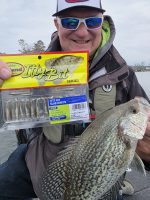
Borrowed from fly fishing, the term “matching the hatch” means observing what forage is naturally present in the water (baitfish, fry or insects, for example) and mimicking those.
“Watch nature. Whatever is in the water, fish a bait that matches it,” he says.
One way to do this is to use a net to observe the color of the minnows in a particular waterway. Dannenmueller says this concept means remaining versatile by downsizing to tiny plastics during fry season or switching to hair jigs that resemble small minnows. Anglers might also adjust color based on local forage.
Myth #6: Crappie Don’t Remember or React to Pressure
Perhaps the most surprising myth? That crappie lack memory.
“They do remember,” Dannenmueller says.
Fish that are spooked or pressured can change behavior and sometimes leave an area for days.
“If they get endangered, they might stay away a week or two,” he says.
Whether on a boat or the bank, stealth matters. Vibrations travel through water, and the fish respond and remember.
Use Technology to Build on the Basics
Modern tools like forward-facing sonar (LiveScope) have transformed crappie fishing, but in Dannenmueller’s view, they’re enhancements, not replacements. The biggest benefit of newer technology is that it helps anglers more precisely target fish and control depth instead of blindly covering water.
For anglers starting out, Dannenmueller recommends relying on simple and accessible resources, including local bait shops, printed lake maps to review structure and contour, and phone apps for basic depth and navigation.
Above all, time on the water is still the best teacher.
In an era of constant innovation, it’s easy to assume that progress means complexity. But crappie fishing tells a different story.
The fundamentals like cork setups, natural bait, observation and patience haven’t changed. They’ve just been enhanced with new tools.
(Anietra Hamper is a career television news anchor and investigative journalist turned award-winning outdoor writer specializing in fishing and outdoor adventure. She travels the world fishing for catfish and other unique species in new destinations.)
