

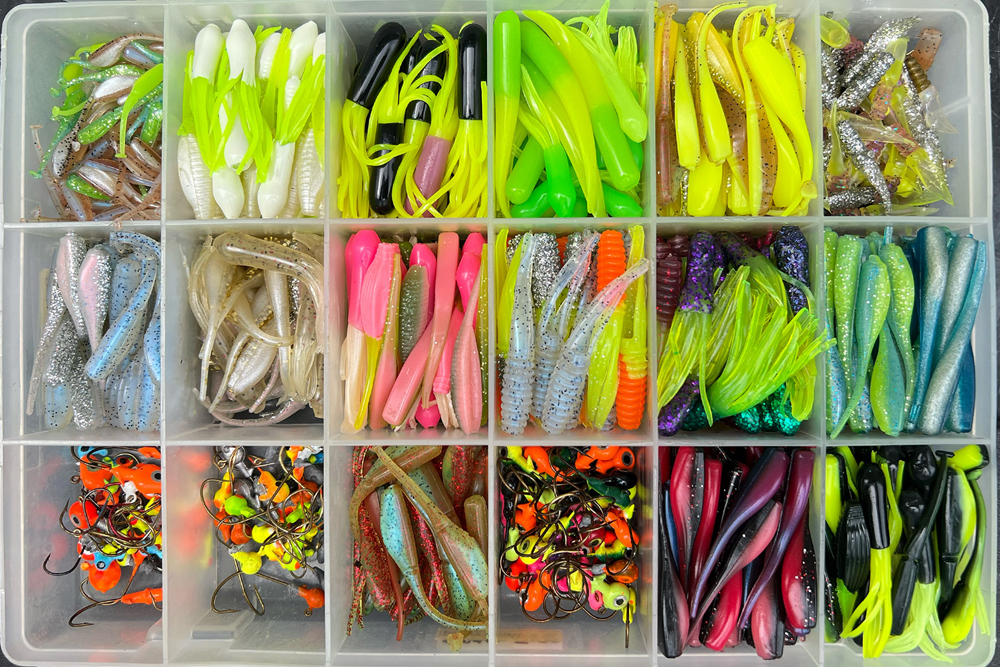
A box of plastic jigs featuring a variety of body styles and
fish-catching colors for clear to dingy waters.
Choosing the Right Jig & Crankbait Colors
Story and photos by Tim Huffman
It’s amazing how many fishermen disagree with me when I tell them there is no doubt an orange/chartreuse jig is the best jig color for catching crappie. Because a fisherman catches hundreds of fish every year on a black/white jig, he doubts my color choice as being number one.
Seriously, every fisherman has a “best bait color” whether fishing jigs or crankbaits. The choice may be correct based upon the type waters he/she fishes and the fishing technique used. If a fisherman has a confidence color that he uses 80 percent of the time, it’s logical that person catches the most fish with it. It’s impossible to say fishermen are right or wrong with their color picks, but rather, it’s choices that work best them in their situations.
Why do we need more than one color? There are a few reasons.
One, water clarity and light penetration make a difference in the best color choice. Therefore, you need different colors when fishing clear water compared to stained water.
Two, light penetration makes a difference, so having dark and light color options is important.
Three, a food source can be different in different seasons, or at different waters. Sometimes matching the food source color is important.
Four, on lakes with heavy fishing pressure, using a different color than other fishermen can be important. Reasons vary for a specific color working better than another. The key is to know it happens so you can take important steps to adjust when needed.
Rules to Remember for Jigs
A general rule is to use dark colors in dark conditions. Examples of dark conditions include dawn, dusk, cloudy/rainy days and night fishing. Dark blue, purple or black matched with chartreuse are good color choices. The theory is that the dark color creates an easier shadow to see against a darker sky.
Another time for using dark colors is in muddy water. Muddy water reduces light penetration, so a dark color is easier to see. Muddy water colors include black, purple, orange, yellow and chartreuse. Having those colors in “glow” could be better.
Light colors are good in clear water, or in stained waters during bright sunlight. A crappie can see a jig better in clearer compared to heavily stained, so white, shad, pink and light blue are good picks.
Many colors fall in the mid-range of colors and often work best in tinted to stained water. Red/chartreuse is a favorite, along with blue/white, orange/chartreuse and many others. Only by testing colors and combinations can a fisherman know for sure which one crappie prefer.
Jig Colors
Monkey Milk. I’ve never seen milk from a monkey but it’s obviously a good color for catching crappie. It’s the number one selling Bobby Garland jig color. The key is a shad and minnow look that triggers bites. The bait has been successful in all water colors. Similar choices include white/chartreuse, white/blue and pink/white.
Chartreuse is good by itself but works better as the secondary color on most light- and dark-colored jigs.
Natural colors like pumpkinseed are good around vegetation including grass, weeds and lily pads.
If limited to only four jigs, which ones would you choose? I’m guessing you would have trouble limiting your choices to only four. This writer’s choices would include monkey milk, orange/chartreuse, black/chartreuse and lime/chartreuse glow.
Crankbait Colors
Mitch Glenn, Pico Lures owner, shares his opinion about crankbait colors. “Best colors can change with the seasons,” he says. “Darker baits are good in the spring because crappie eat a lot of bluegill fingerlings. In some lakes, they eat crawdads. Bluegill patterns with purple and crawdad patterns in dark green or brown are good during the spring.
“Summer is when white, pearls and shad colors are good. Blue chrome in the summer and fall will smoke them where I fish. Sometimes fish will eat anything, but there are times they are very picky. That’s why we make so many colors. Shad patterns have always been a good choice.”
It’s important to note that color isn’t always the most important factor. The pattern design is very important because it creates different shades that are easier for a fish to see, and it has a more natural look than a solid color bait.
“A final tip with crankbaits is to start with six different colors if you’re trolling with six poles,” says Glenn. “Fine tune when you start catching fish. If I don’t have a bite within a half mile of trolling, I’ll be switching colors. It’s best if you don’t continue using what isn’t working.”
Review & Notes
Crankbaits. Pearl white is the most popular crankbait body color, followed by a variety of dark and medium colors, and chrome. Chartreuse, yellow, red, blue and black are popular trim colors. Most of today’s crankbaits are multicolored and patterned.
If forced to only have three crankbait colors in his boat, Glenn says, “I would want Sexy Shad (pearl body with a black/blue back with a yellow stripe), Blue Chrome and Beach Ball (black with a green back and orange belly).”
Jigs. Monkey milk has been proven successful in any water color water but is best in clear water. Other clear-water choices include blue/white, black/white and natural colors.
Stained waters allow using a wide variety of colors, including blues, greens and dark/light color combinations.
Dirty or heavily stained waters can be tough, but black/yellow, black/hot pink, lime/chartreuse and orange/chartreuse are proven choices to try.
All but a few experts interviewed throughout the years agree that a two-color jig is better than a one-color jig, probably because contrasting colors make a jig is easier to see in the water.
Closing
As a writer and crappie fisherman, I believe I have at least three times the number of jig and crankbait colors that I need, but only about half as many as I want. A fisherman can be successful in most waters by having eight colors, but isn’t it more fun having at least 20 or 30 colors? Part of fishing fun is buying new colors that you’re sure will be the ticket to catching more crappie. Choosing colors is a fun and very important part of using jigs and crankbaits. There are no guarantees. Every day is different, so the challenge is finding the best color to get the most action during your time on the water.
(CrappieNOW senior writer Tim Huffman is a member of the Fresh Water Fishing Hall of Fame and Legends of the Outdoors Hall of Fame. Huffman has several books, including Papermouth, Modern Fishing Techniques, available in Kindle or paperback on Amazon, or from his website, www.monstercrappie.com.)
