

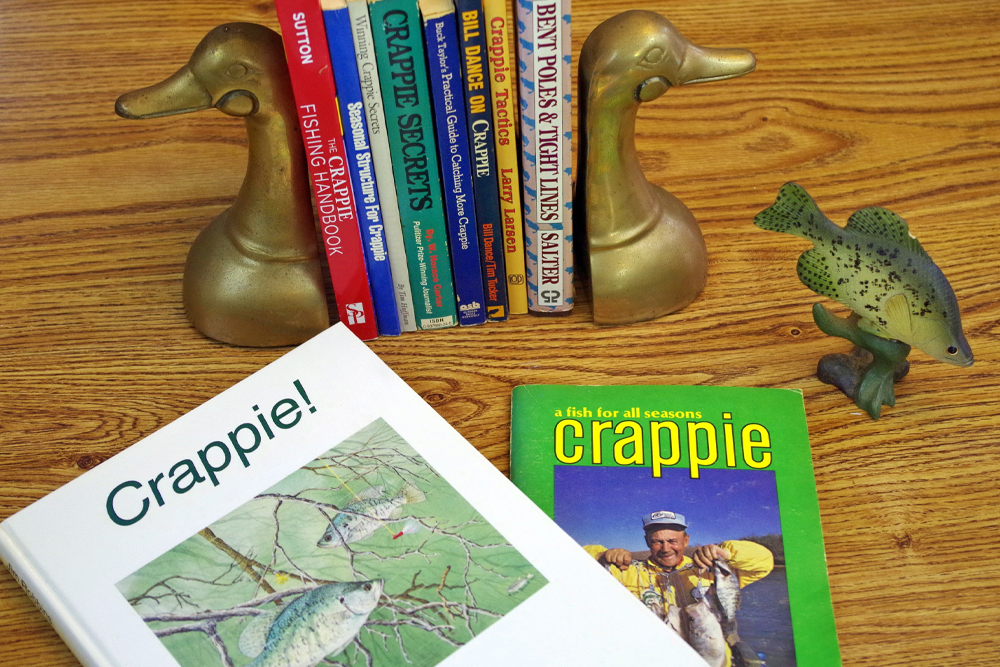
A well-stocked crappie library is as valuable as a full tackle
box—timeless lessons that still put fish in the boat.
Crappie Basics: Start a Crappie Library
By Keith Sutton
Spend enough time chasing crappie, and you’ll learn plenty on the water. But some of the best lessons don’t come from a rod and reel. They come from the pages of a good book.
Serious anglers would do well to build a small library of trusted crappie titles. These books offer something YouTube clips and quick tips often miss: time-tested fundamentals. Seasonal movements, fish behavior and presentation strategies haven’t changed nearly as much as lures and electronics. The anglers who consistently catch more fish are often the ones who understand those basics, and many of those lessons were written down decades ago.
One classic worth owning is “Crappie: A Fish for All Seasons” by Dan Gapen Sr. First published in 1974, it remains one of the most practical, easy-to-understand guides to crappie behavior ever written. Gapen had a gift for simplifying complex ideas, and his insights on seasonal patterns still ring true today.
Consider his take on summer crappie location:
“Summer fishing for crappie should be predicated on two major factors—wind and light. Fish do not have eyelids or irises to shut out or reduce the amount of light striking their eyes. Light penetration is not a problem in spring when the sun’s rays strike the water at an oblique angle. But in summer, as the sun moves higher in the sky, light penetration increases. Thus, crappie are forced to find shade around structures, or by moving deeper.
“The angler should plan accordingly. On cloudy, cool days, crappie usually will not school as deep and probably will be scattered over many different areas. On warm sunny days, they will school more tightly in deeper water or in areas providing optimum shade such as under docks, in weedbeds or brushpiles or even inside hollow stumps.”
That’s as relevant now as it was 50 years ago. When the summer sun gets high and bright, crappie don’t disappear. They reposition. Shade, depth and tight schools become the keys. Ignore those factors and you’ll struggle. Understand them, and you’ll stay on fish.
Books like Gapen’s don’t just tell you what to do. They explain why it works. And once you understand the “why,” you can adapt to any lake, any condition, any day.
I would be remiss in my duties as CrappieNOW editor if I didn’t also recommend the variety of outstanding crappie-fishing books written and published by our own Tim Huffman. Few people have dedicated more time to understanding crappie and teaching others how to catch them. His books blend practical instruction with decades of on-the-water experience and are valuable additions to any angler’s bookshelf. To learn more or order copies, visit www.monstercrappie.com.
So, start building your own crappie library. Keep a few proven titles on the shelf, revisit them often, and let those hard-earned lessons shorten your learning curve. The fish haven’t changed nearly as much as we think.
(Keith Sutton wrote “The Crappie Fishing Handbook.” Autographed copies can be purchased through his website.)
