

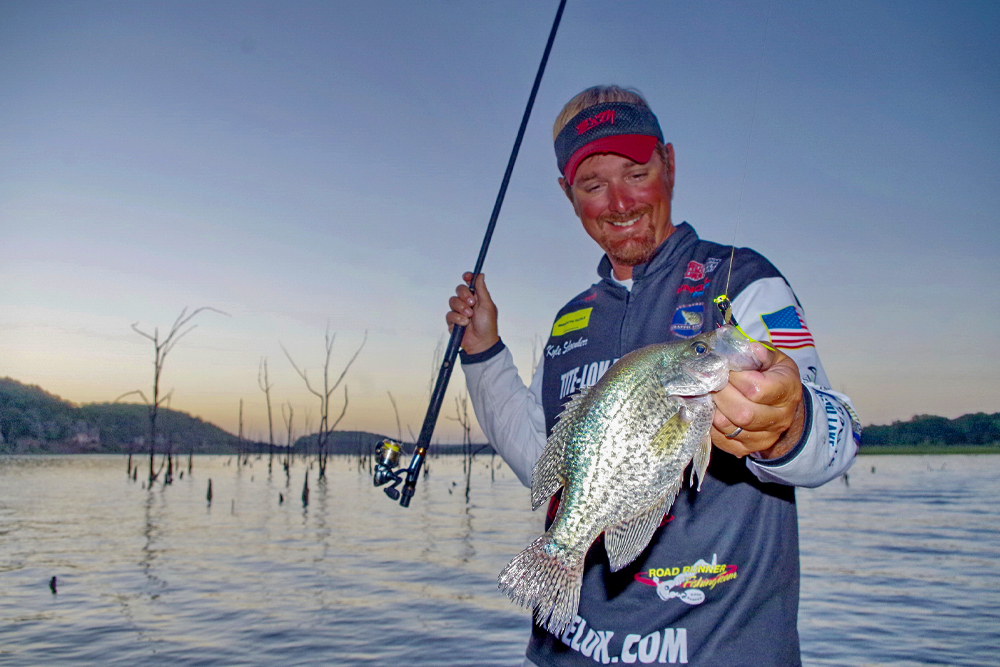
Kyle Schoenherr says September crappie success starts
with understanding the lake you’re fishing.
Crappie Basics: September Fishing Tips From Kyle Schoenherr
Kyle Schoenherr of Oakdale, Illinois is one of America’s top crappie anglers. With tournament partner Rodney Neuhaus, he’s won three National Crappie Championships. He’s also has had more than 25 “Top 3” finishes to his credit and was named the Crappie Masters Sportsman of the Year in 2014. He owns All Seasons Crappie Fishing Guide Service, providing full-time guided fishing on several lakes in southern Illinois.
We asked Kyle to share some basic crappie-fishing pointers for September, and here’s what he had to say.
“Regardless of when you’re fishing or what you’re hoping to catch—big fish or small—the biggest key is understanding the water you’re fishing,” Schoenherr says. “Every lake is different, so it’s important to know the characteristics of each.
“Let me use two of the lakes I guide on as examples. On Rend Lake in September, we usually catch lots of nice average-size crappie, the kind you might want to take home to eat. But Rend’s crappie population includes big crappie, too. When I have clients who are wanting to catch trophy-size crappie, however, I would probably take them to Kincaid Lake where there are lots of bigger hybrids [black crappie X white crappie].
“Kincaid is a deep clear lake that develops a distinct thermocline. Fish there tend to hold as deep as 25 feet in September. Rend, on the other hand, doesn’t develop a thermocline. There we might be fishing much shallower because Rend has murkier, stained water. Different characteristics dictate that we attack the two bodies of water differently.”
“I usually fish jigs,” Schoenherr says. “But the manner in which I fish them can differ every day depending on the crappies’ mood. One day, fishing the lures dead vertical and still might work best. On another day, we may do better trolling. Whether you are successful or not depends on how you present your baits, and knowing the best way to do that comes with an in-depth understanding of the body of water you’re fishing.”
