

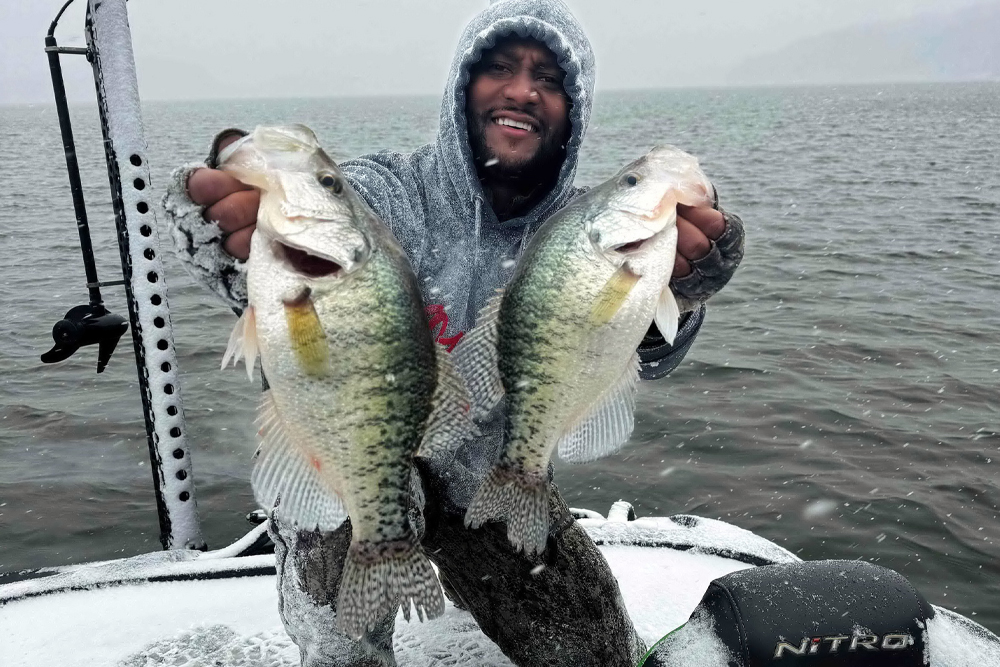
Nothing says winter fishing like an Indiana snowstorm! Ozark Rods pro-staff angler Dante Sezer
shows off two crappie taken during a winter storm in Indiana. (Photo courtesy of Dante Sezer)
Those Winter Sweet Spots
By Richard Hines
It was not too many years ago, few anglers pursued crappie during winter. The normal response was, “Spring will be here soon enough.” I think this was partly due to our gear back then, and we didn’t completely understand crappie biology like we do now.
In any case, crappie fishing has become a year-round pastime for many, and if you are one of those anglers waiting on the sideline, your big question might be, where are those slabs hanging out?
Their needs change monthly
During winter, these fish, like other species, have their own cold-weather niche or what some call “sweet spots.” Many anglers think this depends on your location, but, as it turns out, from the South to the North, there are similarities.
Some similarities hit me immediately when I began thinking about two of my favorite crappie lakes, which are as far apart as you can imagine and not just in miles but terrain. On the Kentucky/Tennessee line is Dale Hollow and, to the far west, Tennessee’s Reelfoot Lake. While they are on nearly the same latitude, both lakes differ in average depth and elevation.
The trend I have been seeing is the amount of time crappie spend in open water on flats. I had begun seeing these similarities and wondered if this held true for other lakes around the country. After spending time with several Ozark Rod pro-staff members, I learned how important flats are. Most anglers overlook these shallow areas.
North Mississippi guide Scott Dees said, “One of my most favorite times to fish is winter. The lake is not crowded, and it seems crappie are easy to locate.”
Dees spends time searching along ledges or elevation drops along old river channels, especially main points of channels where the old bends are located. “When they can, they are gorging themselves, always trying to gain weight for the approaching spring spawn,” he said.
Pro-staff angler Daniel Hays also likes winter, but he locates crappie on structure in deeper water, typically 10 to13 feet deep.
“Once I get on one elevational line where crappie are located, I then begin looking for structure along ledges at that particular elevation, eventually following ridge lines along the deepest water,” he said. “If the average depth of a lake is eight feet, then I search out deeper holes. I always start there and work my way back across the flats until I locate schools of baitfish.”
Wesley Miller, aka “Big Sasquatch,” fishes in northern Louisiana. He said, “Before we had LiveScope, we always thought crappie were hugging the bottom. But that’s not the case, especially if there is any kind of current.” Add in some sunshine and don’t look too deep as crappie will be searching out schools of baitfish.
“Forget the old saying that fish are always deep in deep water,” Miller said. “That isn’t always the case!”
Miller has found it effective to zoom his LiveScope 100-150 feet out so he can identify the next structure. As for techniques, he has noticed that many anglers add a big piece of lead just above their jig. “This seems to spook fish,” he said.
He is now using 4-pound test line with a double jig-rig with 1/8 ounce on top and a 1/16 or 1/32 jig tied behind on a separate leader.
“I learned this technique fishing pressured water,” he said.
LiveScope helped Miller learn that time after time fish seem to check out the larger weight only after they checked out the smaller bait. In this case, the 1/8-ounce jig is now your weight, but with a hook. Double the hooks and double the bite.
He believes you should avoid bright colors and use natural tones that are about 1.5 inches long. Don’t stay locked on one spot too long. Sometimes crappie are near a school but not feeding. In that case, look for another school.
Nathan Noblitt agrees with downsizing, at least until the bite is on. Then it’s time to upsize your bait. Even in Louisiana where Noblitt fishes, many anglers are surprised to find winter crappie staying in the shallows, even in three to five feet of water. His rule of thumb is, “If the water is 45 degrees or above, fish are feeding on the flats.” He likes combining both LiveScope and side imaging to locate baitfish because crappie will be there.
Crappie are in the shallows even up North.
You shouldn’t think crappie only hang out in shallow water down South but not up North. That’s wrong because crappie are biting all winter, especially on sunny days.
Indiana winters don’t slow Ozark pro-staff angler Dante Sezer. He said, “When October 1 rolls around, everyone is thinking about deer hunting, and crappie go to the sideline. But just because we are up North doesn’t mean we have to quit fishing.”
Flats are Sezer’s go-to sweet spots in winter. “Even here in Indiana, big crappie are roaming the flats in only five to six feet of water,” he said. He believes this has helped provide some hideouts for older, bigger fish.
Sezer has found that the deep channels everyone thought were sweet spots might not be. When flats are loaded with baitfish, that’s where you’ll find crappie.
Sezer’s main winter tactic includes a 13- to 15-foot Ozark Rod rigged with a pink or chartreuse head and a clear or light neutral color body.
His overall advice for winter is “Go slow.” Fish that are on these flats have seen it all, which makes them very finicky.
Do they need big baitfish?
Not really, because, believe it or not, crappie will readily feed on small invertebrates that are large enough to see without a microscope. Amphipods are their number one choice. Throughout the year, these small shrimp-looking inverts spend the day breaking down leaves and such, but they also help support many fish, including crappie when pickings may be slim. So, don’t think your bait is too small!
(Richard Hines is a retired wildlife biologist, book author and award-winning freelance outdoor writer and photographer. Since 1985, Hines has appeared on various radio and TV shows and has published hundreds of articles on hunting, fishing, conservation and natural history.)
