

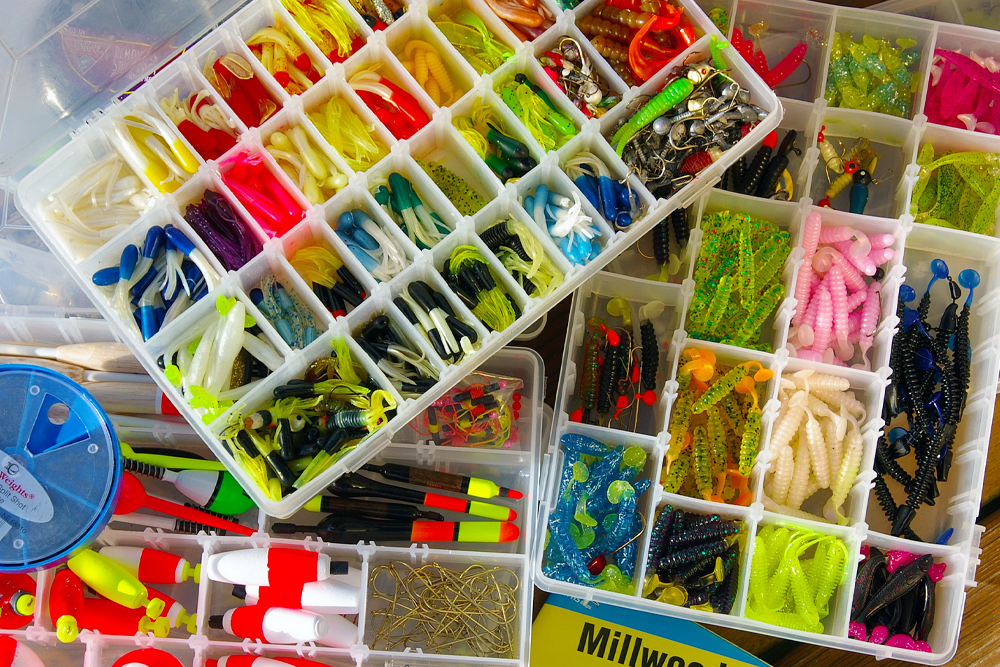
The author’s tackle box has several plastic boxes with dividers to create multiple
compartments for keeping a variety of jigs in different colors, sizes and styles.
Crappie Basics: The Well-Stocked Tackle Box
By Keith Sutton
There are innumerable styles of tackle boxes on today’s market. The one you select will depend largely on how much crappie fishing tackle you carry on each outing, the type of tackle you use and, if you’re budget-conscious, the price.
For beginning crappie anglers, the best tackle box isn’t necessarily the biggest or most expensive. It’s one that holds the equipment you need, keeps everything organized and makes it easy to find what you’re looking for when you’re on the water.
If you’re primarily a minnow fisherman, a small box that accommodates a selection of hooks, bobbers, sinkers and fishing line may suit your needs perfectly. But if you fish with both jigs and minnows, you’ll probably want something a bit more elaborate. Crappie anglers who use different jig styles, colors and sizes need enough compartments to keep those lures separated and easy to access.
I tried a variety of tackle boxes—cloth bags, over-and-unders, tilt-trays and more—before finding my favorite. Most didn’t have enough tray compartments to organize my jigs. And those that had an ample number of compartments didn’t have space for larger tackle like spools of line and extra reels.
I finally settled on a model that opens at the front to reveal three slide-in, slide-out, worm-proof plastic tackle boxes, each with dividers that can be custom-fit to create up to 24 compartments. That’s a total of 72 compartments, each just the right size for a couple dozen jigs and jig heads. By purchasing additional small slide-in boxes, I can organize more tackle and switch out selections when changing fishing tactics or pursuing species other than crappie.
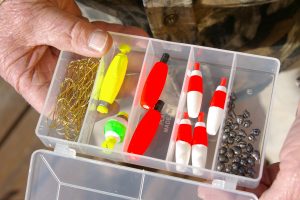
This kind of organization is especially helpful when you’re carrying a variety of jig sizes and colors. Keeping similar items together makes it easier to locate the right lure without digging through a jumble of hooks and plastic baits. It also helps prevent small tackle from becoming mixed together or lost.
For example, in summer I often use small jigging spoons to catch crappie holding around deep structure. That’s the only season I do much spoon fishing, so I’ve organized a small box full of spoons that replaces one of the jig boxes on my summer outings. Rather than carrying tackle I won’t use, I simply take along the equipment suited to the fishing conditions.
The removable boxes are also a boon when planning a trip where I’ll fish for bream, catfish, bass or other species in addition to crappie. Slide out a box of jigs, slide in a box of bass lures. There’s no need to reorganize the entire tackle box every time fishing plans change.
My tackle box also has an extra-deep top compartment for bulkier gear like stringers, fishing line and extra reels. Depending on the size of your box, this space can also be useful for storing small tools, scissors, hook removers and other items you want readily available.
Whatever style you choose, keep a few basic principles in mind. Organize tackle so you can find it quickly, avoid carrying more than you need, and periodically check your supplies before heading out. Make sure you have an assortment of hooks, sinkers, bobbers, jig heads, jigs and replacement line appropriate for the way you fish. A few extra items are always handy, too, because tackle can get lost, damaged or used up during a day on the water.
A well-stocked tackle box doesn’t have to be complicated. It simply needs to be organized around your fishing habits, equipped with the essentials and flexible enough to accommodate changing conditions. When everything has its place, you’ll spend less time searching for tackle and more time doing what you came to do—catching crappie.
(Keith Sutton has been writing to teach others about crappie fishing since the early 1980s. His trips in pursuit of these scrappy black-and-white panfish have taken him to prime waters in more than 30 different states.)
