

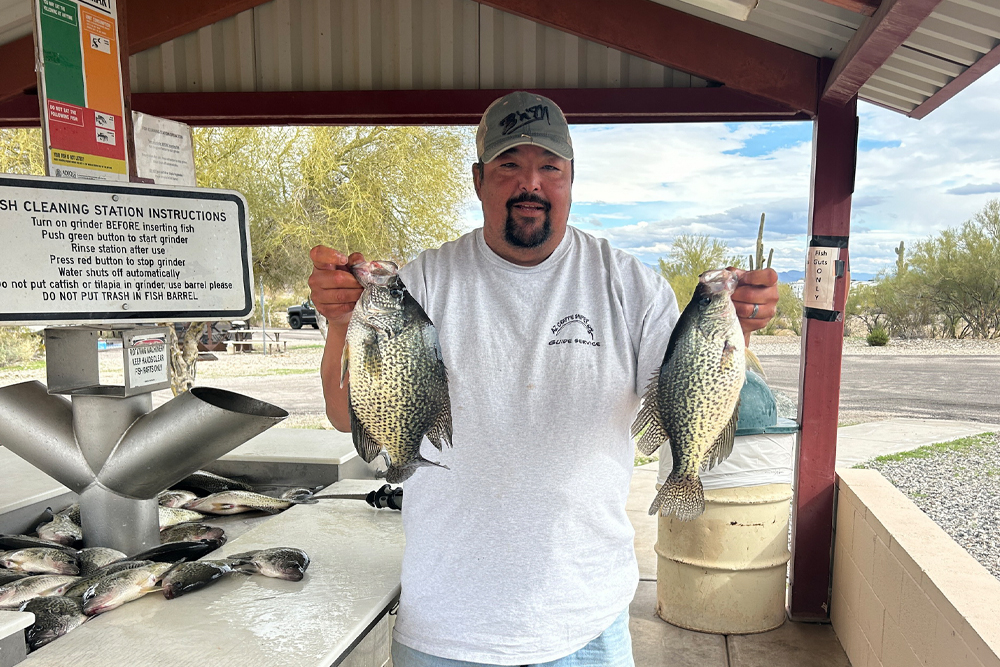
Dropping a 1/8-ounce jig in front of a desert reservoir slab crappie has been
a specialty of Randy Howton. His love for crappie fishing and taking others out
started after the passing of his father and many hours dedicated to perfecting
his skills with live imaging sonar.
Arizona Crappie at a Distance
By Scott Mackenthun
Photos courtesy of Randy Howton
When Randy Howton lost his father in 2020, he returned to the water where the father and son duo had enjoyed so much time together fishing. Getting back in the boat and fishing was therapy, but without his father as fishing partner, it all felt a little empty at first.
Howton picked up a Garmin Fishfinder and taught himself how to LiveScope fish. He had always been a bass angler but enjoyed chasing crappie in the spring.
“I watched a few YouTube videos, got some ideas and thought, ‘Well, if I can go out and catch a few crappie, maybe my wife wouldn’t be so mad at me for buying this LiveScope,’” he said. She loves to eat crappie and wouldn’t have to wait until March or April to get some again.
“On my very first day out there messing around with the LiveScope, trying to figure things out and see what I was seeing, it was a lot of driving around looking and looking,” Howton continued. “I think I did catch one little bass off a point. Then right at the close of that day, I saw a little glowing spot sitting inside a mesquite tree about 15 feet under the surface. I had a little crappie jig tied on, and I dropped the jig on that tree. That crappie shot out about 10 feet to grab the jig way before it even got to the tree. I just thought that was the most exciting thing I had ever seen. One little crappie jumping out of a tree to eat my jig just changed my world.”
That very first crappie got the wheels spinning. Howton went home and studied everything he could find on crappie patterns. His time on the water increased, and so did his catch.
“My next time going out, I found a tree that had a bunch of fish in it,” he said. “I started working that tree, and I ended up taking home 10 crappie. For me, that was such a huge accomplishment to bring home 10 nice fish in November for my wife. I felt like King Kong!
“From that moment, I was hooked. I couldn’t wait to get back out. Every day I had off, I was back out on the reservoir just looking in the water. Having eyes under the water for the first time in my life was a dream come true. And going from catching crappie only in March and April to catching them year-round was a big change. I was hooked. Things just exploded from there.”
As the catching became more regular, Howton craved companionship. So, he started posting his open boat seat to interested armed services veterans on Facebook who wanted to catch some crappie.
“One thing led to another,” Howton said, “and before you knew it, people were leaving money in my boat and trying to talk me into taking their friends and family out.” Howton picked up his guide’s license and has been on the water ever since.
“Crappie fishing in Arizona is a whole lot different than the Midwest, the East Coast or the Southeast,” he said. “We have really ultraclear water compared to what most people are used to fishing from wherever they call home. As a result, these crappie don’t let you get close to them like they do elsewhere. We can’t drive up on them and chase them down with a fishing rod. These fish are not necessarily too pressured, but the water is just too clear. You have to learn how to cast and be accurate.”
Howton noted that crappie in Arizona reservoirs are sometimes roaming in open water or hanging tight to structure like old trees. But the biggest factor in an angler’s success is keeping space between you and the fish.
“Distance is key,” he said. “No matter if they are roaming or on structure, we have to keep our distance to be more successful than the next guy. You get too close and you’ll push them off or spook them. The farther away you can stay, the more fish you’re going to catch.”
The go-to forage on Arizona reservoirs is shad, Howton said, as the reservoirs are full of shad that fuel fast growth.
“We don’t have bugs, shrimp, leeches, emerging insects,” he said. “We have a lot of hard rock, which isn’t the best for bugs. You’ll find some crappie eating crayfish, but that’s mainly a fall pattern. Shad are it. We have great growth and healthy shad populations. We have crappie that will grow to a couple pounds in a few short years. Our crappie are fast growing, but short lived.”
Howton said that besides the clear water making the fish spooky, most of the reservoirs in Arizona don’t have a lot of crappie despite their massive size, so he’s busy searching for needles in a giant haystack most of his time in the boat.
“I am always zoomed out with my LiveScope to 100 feet and I’m scanning and casting for my fish.”
Howton’s go-to fishing setup for Arizona crappie at a distance is a B’n’M Sam Heaton Super Sensitive rod in nine-foot length.
“I can hit a fish on the head at 90 feet very, very consistently with that rod and a 1/8-ounce jig, he said. “So, that’s what I’m using about 90 percent of my time on the water.”
Howton said that the splash of a heavier weight will spook fish, so the 1/8-ounce jig is the largest he will throw.
“There are times when the fish hold a little deeper, and I’ll put on a 1/8-ounce tungsten inline sinker just above my jig,” he added.
Howton runs 10-pound braid that has 2-pound equivalent diameter to monofilament, tied off to a 10-pound-test fluorocarbon leaders. The braid gives Howton and his clients the sensitivity needed to feel the bites. All the casting is done from Pflueger President spinning reels.
“I can shoot that setup from a Sam Heaton B’n’M with a Pflueger President 110 feet without a problem,” he noted. “That reel is a workhorse; my clients put them through a beating every single day.”
Howton places his electronics on Cornfield Fishing Gear Mounts.
“I can sometimes find a structure that’s loaded with fish, park 60 feet away, put the boat on Spotlock and cast to those fish all day without ever spooking them.”
Howton’s experience shows that the fish move constantly in Arizona reservoirs. He starts his searches in creek arms, but he makes his living by staying on the move. He may find crappie holding on a tree one day and nowhere near that area the next.
“I cover lots of water,” he said. “Out here, our lake levels rise and fall a lot. We have lakes that drop 30 feet in four or five months. You go back to a waypoint and it’s clear out of the water. Every day is a new search. The people that search the most are going to catch the most fish. In winter, I’ve seen a school of shad come over a mesquite tree that was loaded with fish, and every one of those crappie came out of that tree, chased that school of shad and ended up 150 yards down the river arm in another tree.”
If you want a chance to fish Arizona crappie at a distance, you can find Randy Howton’s AZ Crappie Sniper Guide Service on Facebook, by calling 623-640-9193 or by emailing randyhowton@yahoo.com.
(Scott Mackenthun of New Prague, Minnesota has been writing about fishing since 2005. He is a fisheries professional, father and avid angler when he’s not writing about his time on the water. He can be reached at scott.mackenthun@gmail.com.)
