

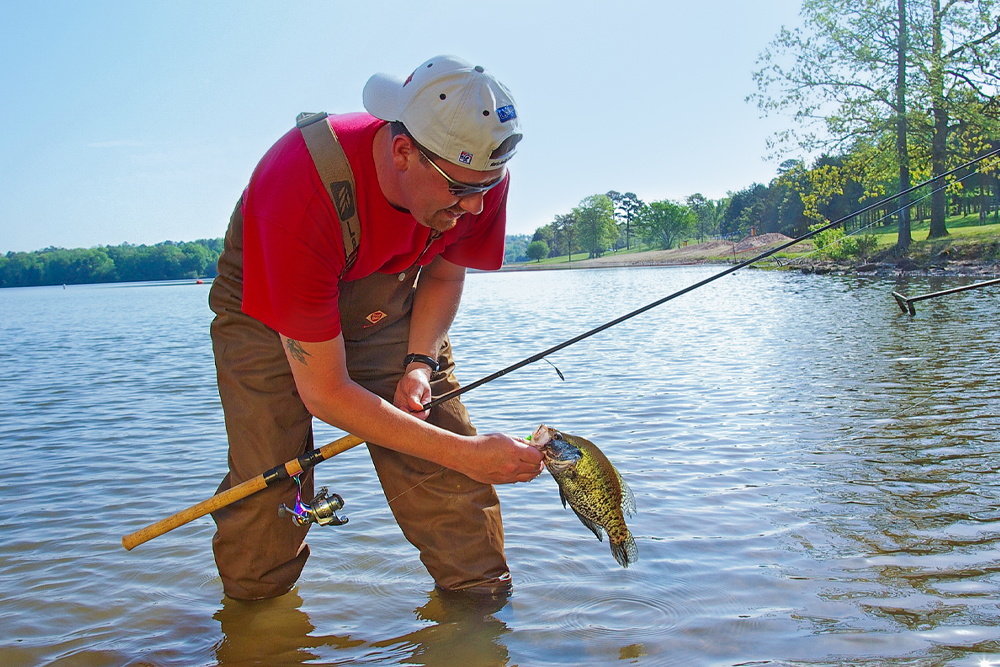
Crappie have excellent camouflage, making them difficult to see even
when in clear water. But astute anglers can learn to spy these calico panfish
on their shallow spawning beds and catch them by sight fishing.
Crappie Basics: Sight Fishing for Spring Slabs
Photos and Story by Keith Sutton
Many anglers rely on sight fishing to catch their favorite species. In clear mountain streams, fly fishermen spot trout and drift a fly within easy reach. Bass anglers on the bow of a boat cast to spawning largemouths in the shallows. And from a johnboat, a fisherman may watch for the “honeycomb” pattern of bluegill beds.
Sight fishing for crappie, however, remains a rarely used tactic.
Part of the reason is the crappie’s fondness for cover. Unlike bass and bluegills that often nest on open bottom, crappie prefer bedding areas filled with flooded vegetation, brush, logs or stumps. Trying to spot fish in such places can feel about as productive as stargazing on a cloudy night.
Crappie camouflage adds to the challenge. Their mottled coloration blends perfectly with shadows and submerged wood, making them nearly invisible to untrained eyes.

Another complication is depth. In clear lakes, crappie sometimes spawn 10 to 20 feet down. Their nests are also poorly defined compared to the obvious beds of bluegills. Even in clear water, both the fish and their nests can be difficult to see.
Yet there are times when sight fishing for crappie can be surprisingly productive, especially during the peak of the spawn. For several weeks each spring, crappie move into the shallow zone between deep water and dry land. If you know when and where to look, you can use your eyes to locate bedding fish.
If you’ve fished a lake before, start with known bedding areas. Undisturbed crappie often spawn in the same locations year after year.
When fishing unfamiliar water, study a contour map or use electronics to locate likely spawning zones. Look for creek channels that swing close to shore. Crappie often follow these channels from deep water and spread out along the edges where suitable spawning cover exists. The backs of feeder creeks can be productive as well. Also watch for migration routes leading to shallow cover—stump rows, old fence lines, weed lines or ditches. The ideal combination is shallow water with abundant cover and a firm bottom.
Some of the best sight-fishing opportunities occur when rising water floods brushy shorelines or low woodlands. When these areas become temporarily submerged, crappie may abandon traditional spawning sites and move into the flood pool. In such places they are often easier to see, especially along the shallow edge of the high water.
Wading is often the best way to reach these areas, though a carefully positioned boat may also work.
Wear polarized sunglasses when sight fishing. They cut surface glare and allow you to see much deeper into the water. With good polarized lenses, you’ll spot far more fish than you would otherwise.
Look for either the fish themselves or signs of their presence when searching for crappie. Sometimes you’ll notice a fin or tail breaking the surface or the faint outline of a fish hovering over the bottom. A motionless crappie can be extremely difficult to detect, but experience helps you distinguish fish from their surroundings.
More often you’ll notice movement—a shallow wake as a male chases away intruders or a swirl when a crappie rises to grab a minnow.
When you spot one fish, stop and carefully scan the surrounding area. On a good bed, you may find a dozen or more crappie nearby. Knowing where several fish are located helps you decide which one to target first without spooking the others.
When you pinpoint fish, present a bait right in front of them. Some anglers prefer a long jigging pole to swing a jig or minnow quietly to each crappie. Others use spinning or spincast tackle to work from a greater distance.
In brush or weeds, a long pole works especially well. Stand where you can clearly see the fish, extend the pole and lower a jig or minnow gently into the water. Often no movement is necessary. If the crappie is feeding or guarding its nest, the strike usually comes quickly.
Of course, you don’t have to see crappie to catch them. But watching a fish finning over a bed and placing a lure directly in front of it adds a special thrill to spring fishing. And when you can see the fish before you cast, your casts-to-hookups ratio often improves dramatically—a good reason for any angler to give sight fishing a try.
(CrappieNOW editor Keith Sutton is an Arkansas outdoor writer, photographer and author of several books on fishing and hunting. Formerly the editor of Arkansas Wildlife magazine, he has written hundreds of articles on freshwater fishing and is widely recognized for his expertise on crappie angling. Sutton enjoys sharing practical techniques that help anglers consistently catch more and bigger slabs.)
