

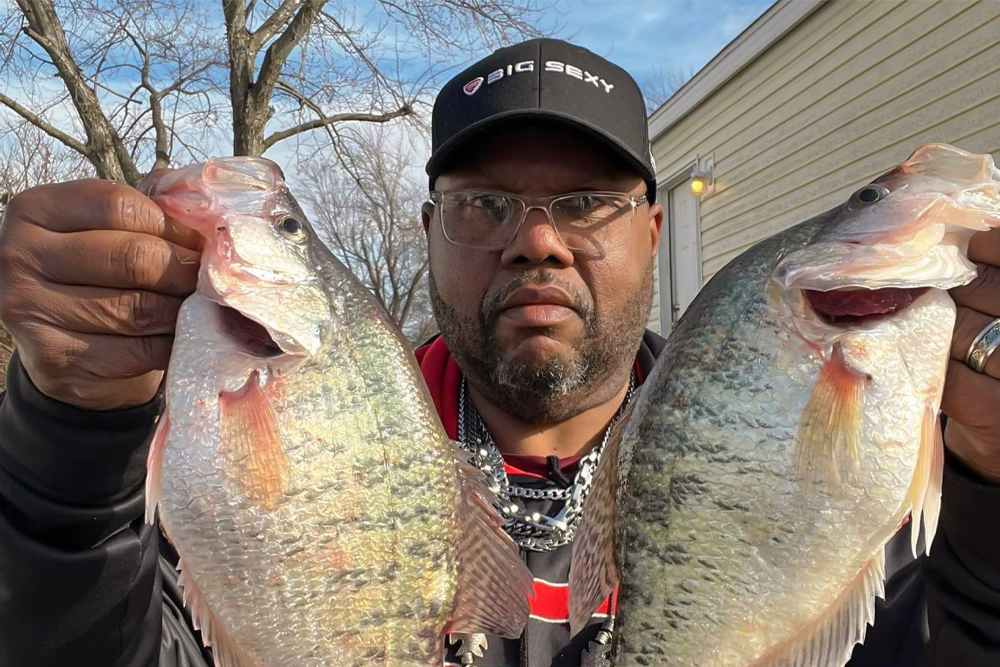
Kim Burnett uses his flies he ties to catch big spring crappie.
Crappie Fishing on the Fly
by Brent Frazee
Photos courtesy of Kim Burnett
Tiny bait, big fish. That’s Kim Burnett’s philosophy on catching bragging-sized crappie and bluegills in the spring.
Once the water temperatures creep into the 50s, you’ll see him sneaking along the shorelines of small Kansas impoundments with flyrod in hand, ready to launch one of the flies he ties for his Crappie Stopper Jigs company. He’ll leave the minnows and plastic jigs to others. He would rather fly fish with his insect-like creations.
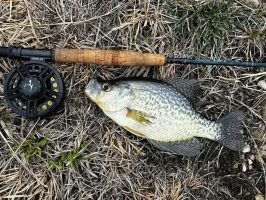
“People will watch me catching them and they’re just amazed,” said Burnett, who lives in Olathe, Kansas. “They ‘ll say, ‘I didn’t know you could fly fish for crappie.’
“They think that’s mostly for trout. But the little insect flies I use will catch crappie and bluegills, too.”
Burnett also ties the larger hair jigs that many anglers will use to catch big panfish. In fact, that’s how he got started in the lure-making industry 35 years ago. He got tired of replacing plastic jigs that were torn up after catching several fish, so he decided to start making his own hair jigs.
When Burnett started catching crappie off marina docks, even when the bite was slow, he drew an audience. He started handing out his jigs and “planting the seed,” as he put it.
“Finally, I realized I had to start charging for them,” Burnett said.
Fast forward 11 years, and he began to downsize his offerings by tying 1/80th-ounce and lighter panfish flies.
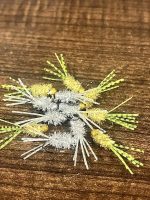
“I knew that black crappie especially like to eat a lot of bugs,” he said. “They’ll feed on nymphs, little insects and larvae, especially when there isn’t a lot of other forage around. So, I started tying some flies that imitated those little bugs, and I caught a lot of fish on them.”
Burnett now ties, sells and uses five types of wet flies designed to sink slowly and attract crappie and big bluegills when they move shallow.
- The Dreamweaver Bee imitates a small bumblebee.
- The Gill Buster, in both black and gray, is similar to a small aquatic insect.
- The House Fly imitates flying insects.
- The Damsel in Distress looks like a small damselfly.
- The Mohair Leech imitates a small leech.
Burnett will use a strike indicator to launch the flies that are in the 1/80-ounce range. If the flies are even lighter than that, he will wrap thin lead wire around the hook to get them to sink.
He ties those jigs and flies one at a time in his basement, then sells them through his website.
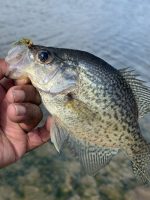
He uses a 5-weight, 9-foot-long flyrod when he is pursuing panfish. He uses weight-forward fly line made by Scientific Angler. He’ll also use a leader and 4-pound-test tippet to complete his setup.
Burnett will conduct his shallow-water search for crappie from late February through May. By the time the crappie spawn tapers off, the bluegills will move shallow for their spawn, and Burnett will target the craters the panfish make to catch the big bulls.
“When I’m in a boat, I’ll use side imaging to locate the nests. Then I’ll stay back a ways and cast to them,” he said.
Burnett has no shortage of places to flyfish for big crappie and bluegills. He often targets small public lakes in the Kansas City area and fishes from shore. But he also will fish coves in larger northeast-Kansas reservoirs such as Clinton and Hillsdale.
The biggest crappie he has caught off one of his flies weighed 2 pounds, 12 ounces. But he catches dozens of fish 1 pound and larger each spring.
“It’s just a fun way to fish,” Burnett said. “When you’re using a flyrod, you can’t horse them in; you have to play them.
“A big crappie will give you all the fight you want on a lightweight flyrod.”
(Brent Frazee is a fish head who lives on a 150-acre private lake in a Kansas City suburb. He was the outdoors editor of the Kansas City Star for 36 years before retiring in 2016. He continues to freelance for magazines, websites, and newspapers.)
