

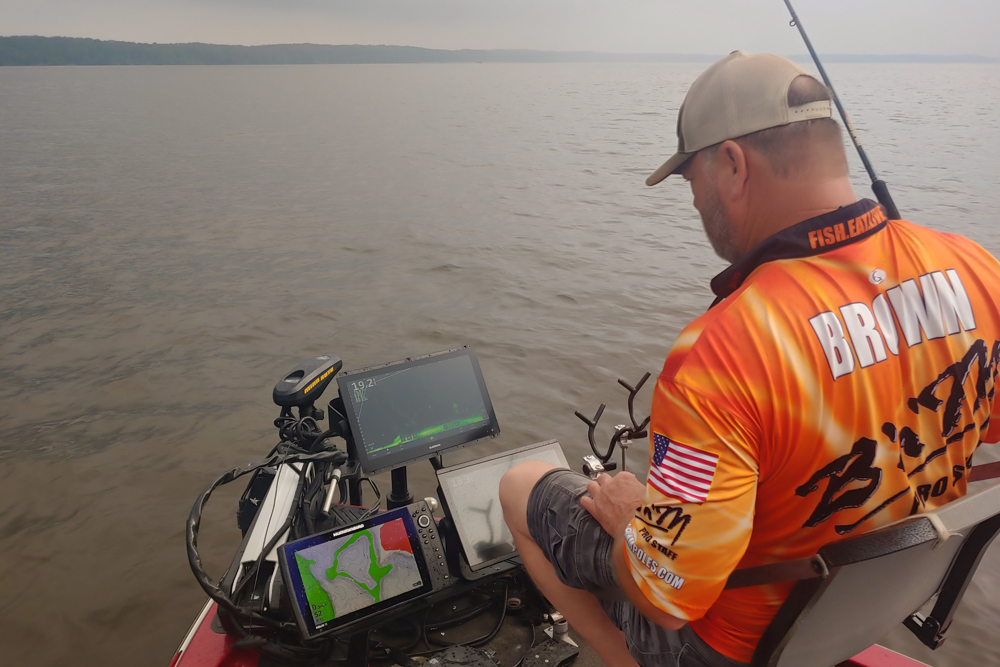
Tournament angler Steve Brown keeping an eye on his electronics.
The response of postspawn crappie can quickly become evident
when using LiveScope. (photo by Richard Hines)
Downsize For Postspawn Crappie
By Richard Hines
One of my longtime fishing buddies, Joe McDonald, used to say, “When the bite is slow, downsize the bait and upsize your fish.” I’m not sure where he first heard that or if he made it up, but it worked on many of our trips.
I later found out that this concept applies to crappie, especially during the postspawn period. For years, I had tried to catch big fish on big baits at the wrong time. Like many anglers, when the spawn was winding down, I assumed crappie were hungry and looking for the biggest, fattest baitfish in the lake. But last year, when I had the opportunity to fish with Steve Brown on Ross Barnett Reservoir near Ridgeland, Mississippi, he got me back on the right track.
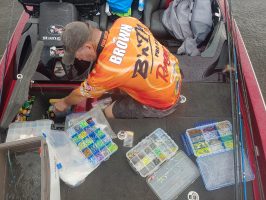
Brown, who is a well-known crappie tournament angler from Millbrook, Alabama, is one of the Pro Staff members for B’n’M Poles. Both Steve and I were fishing this lake for the first time, and after some time on the water, it was obvious the crappie spawn was on the downturn but not completely over. That is when Steve suggested that we downsize our baits.
To many anglers, it doesn’t make sense to reduce bait size, especially for fish that are obviously hungry. Why wouldn’t a crappie go for the biggest morsel in the lake? However, when talking about any type of predators, even crappie, both wildlife and fisheries biologists have understood this concept for many years: that feeding or energy intake must be greater than energy expended. A nice fat baitfish looks good, but how much energy does it take to run it down and catch it? Many times, smaller prey may be more abundant and, if it takes little or no effort, then the same amount of food is taken in with less energy expended. This principle applies to all species at some point in time, and for crappie, this time is during the postspawn.
Breaking Beds Means Downsizing
Fishing during the spawn can be successful, but once crappie begin “breaking beds,” it is still far from business as usual. Brown said, “Postspawn crappie are not feeling good, and they are sure not eating. The only way to entice one is downsizing your bait, including your jig head.
“Of course, an angler may not have a smaller bait in his tackle box,” Brown said as he grabbed a Bobby Garland bait from his box and bit off part of the main body. “Just cut them off or bite them off near the head. The idea is to have a smaller profile bait in the water.”
Cutting off one or two ribs near the head on these baits is all it takes to reduce the profile.
This is now a pretty standard technique among most guides. Billy Blakley, head guide at Blue Bank Resort on Reelfoot Lake said, “When crappie are breaking beds and haven’t moved back into deeper water yet, I downsize to smaller baits. I generally go with a 1/16-ounce head and always step down my line to 4-pound test.”
Blakley wrapped it up well when he said, “Slow down your retrieve and downsize your bait for postspawn crappie.”
Don’t Overlook Colors
Which color Billy Blakley or Steve Brown use varies according to the water color. A good standard rule for stained or muddy water should include a slightly larger profile.
Brown said, “For stained water, I like a pink head jig with black and chartreuse tail, but when fishing in extremely muddy water, profiles seem to be the most important factor to consider. While these darker water colors make it essential that you use bait easily seen, it’s just the opposite when fishing in clear water. It’s all about being seen but being less conspicuous. In clear water, you should always avoid bright colors, which are greatly magnified in the transparent water, making them appear completely unnatural. When fishing clear water, consider using clear, silver or another light color.”
Brown and Blakley both like having a small amount of light blue on lures in clear water.
Consider Jig Size
I have been an ultralight angler for many years, so I have a good selection of small baits. On more than one occasion, I have downsized baits to finally coax a bite from fish I could see and that seem to be bypassing me.
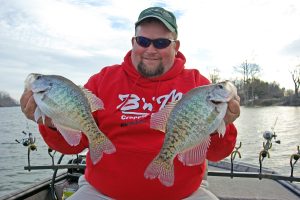
If fish ignore your normal-size grubs or other baits, keep a selection of smaller jigs and plastics to match smaller baits. I have jigs as small as 1/48- and even 1/64-ounce. When you use baits this small, you may have to go to a 2-pound test line.
Another mistake many anglers make is pitching at a few good-looking spots a few times and quickly moving on. Keep in mind that as female crappie are moving off beds, they are sluggish and not interested in feeding. Anglers who have fished LiveScope for many years see this time after time when they pull a bait by a suspended crappie that shows zero interest.
When you see this, you know it’s time to downsize your bait. This applies to live bait as well as artificial.
Just don’t bite your live minnow in half! Most bait shops have smaller minnows available.
(Richard Hines is a retired wildlife biologist, author and award-winning freelance outdoor writer and photographer. Since 1985, Hines has published hundreds of articles on hunting, fishing, conservation and natural history.)
