

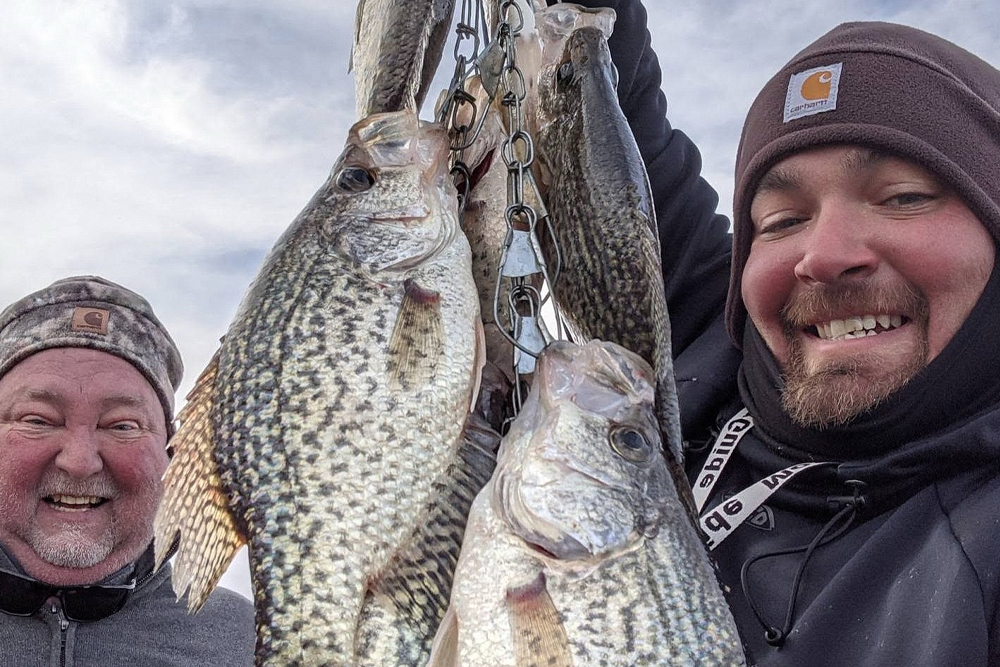
Guide Kris Nelson (right) and his customers know that Stockton Lake’s fall crappie fishing is something to smile about.
Fall Crappie on Missouri’s Stockton Lake
By Brent Frazee
Photos courtesy of Tandem Fly Outfitters
It’s hard to imagine that a 25,000-acre reservoir in the Missouri Ozarks is somewhat of a secret to crappie fishermen. But that’s the case with Stockton Lake, a clear-water gem in the southwest part of the state.
Fishermen flood to its neighbors, Truman Lake and Lake of the Ozarks, which are known nationally for their crappie fishing. Stockton, with its largely undeveloped shorelines, gets far less fishing pressure … and attention.
Fishermen don’t know what they’re missing. Stockton has quietly developed into one of Missouri’s best crappie lakes. And it shines during the fall months when some of the best fishing of the year takes place.
“I run most of my guide trips during the week here in the summer,” said Kris Nelson, who runs the Tandem Fly Outfitters guide service on Stockton. “If we see five or six other boats, it’s crowded.
“My clients will say, ‘Where is everybody?’ I’ll tell them, ‘This is normal at Stockton.’ “
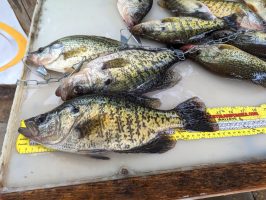
It’s also normal for Nelson’s customers to catch limits of big crappie. He guides for the Ozarks panfish year-round and has developed a knack for tracking the location of his target species.
Though he also is known for guiding clients to Stockton’s walleyes at certain times of the year, he said, “Crappie are our bread and butter. That’s how we pay our bills.”
At few times of the year is the fishing better than in November and early December.
The daily limit for crappie at Stockton is 15 fish 10 inches or longer, and there are few days when that limit isn’t met.
Nelson’s Facebook page (Tandem Fly Outfitters) is filled with photos of happy fishermen displaying large stringers of fish.
“We catch a lot of fish in the 11- to 12-inch range,” Nelson said. “Stockton just has a lot of good, healthy crappie.”
Fall’s cooldown
As the water cools, it sets off a chain of events that benefits crappie anglers. It centers on the behavior of the shad, the crappie’s main forage.
Once the water temperatures drops, the baitfish leave the clear-water brush and head to the back of creeks to feed on algae and plankton before winter sets in. Predators such as largemouth and white bass follow them there and often go on a feeding spree. But in Nelson’s experience on Stockton, the crappie remain in the brush and often get hungry with their sudden lack of accessible food.
“Some crappie might move part way back in the creeks,” Nelson said. “And if there’s standing timber in those creeks, they might set up there. But they don’t generally make a big push into the creek arms.
“By the third or fourth week of October, they haven’t had as much baitfish around them, and they’re hungry. They’re much easier to catch.”
The crappie usually stay on brush until the third or fourth week of November, depending on the weather, Nelson said.
When the water gets cold enough, the baitfish will move to the channel of the Sac River and begin to cruise. The crappie will follow, and both will suspend over deep water as they move.
“There is a two to three-week period in early December when they will load up on the closest brush to the river channel, and the fishing is crazy,” Nelson said. “As the water gets colder, they’ll move into the channel itself.”
Find the food, find the crappie
From that point, the key is locating big balls of shad. Where the baitfish are, the predators won’t be far away.
That can involve hours of looking. But once those concentrations of baitfish are located, it can result in hot fishing. And not just crappie. Nelson has caught everything from crappie to walleyes to white bass out of one school of shad.
That’s the good news. The bad news is that those schools of baitfish and crappie seldom stay put. Just because they were in one stretch of water one day doesn’t mean they will be there the next.
Efficient electronics are a must. Nelson uses his fish-finding units to track the location of the schools. It can be a long search. He often finds the baitfish will relate to bends in the river channel, especially those with brush or pole timber in them, or ledges.
“I remember one time when a customer at the front of the boat was catching crappie, and another one in the middle was catching walleyes,” Nelson said. “Those fish were set up on different parts of that drop-off.”
Catching them
Nelson has his clients fishing vertically for fall crappie most of the time. But he doesn’t rely on forward-facing sonar to put his fishermen on fish.
“A lot of my clients are elderly and can’t climb up on the front deck to fish,” he said. “I might use forward-facing sonar to find out what the fish are doing, but if I get over the top of the schools of fish, I’ll guide them from there.”
Nelson uses 6-foot-7 Crappie Slammer rods and Crappie Slammer plastic baits. He uses 5-pound test braided line and ties directly to the jig head to give his customers the best feel for hits in the deep water they often are fishing.
The size of the jighead differs with the depth at which the group is fishing. He often goes to 3/16-ounce heads for the deeper fish.
At home on Stockton
Nelson took a circuitous route to get to Stockton.
He was brought up in Willard, Missouri, about 45 minutes from the lake. But he had an adventurous spirit, moving to the Florida Keys, where he got his captain’s license and started running a 60-foot sportfishing yacht.
He later moved to Branson, Missouri, where he opened a guide business that served trout fishermen on Lake Taneycomo and multispecies on Table Rock and other lakes.
But he got tired of the crowds, and he and his wife Amanda opted to take a gamble and open a guide service and lodge at Stockton Lake.
Today, they and their two children live in a house overlooking the lake, and they lease a house to put up their groups of fishermen.
They’ve never regretted their decision. While Nelson also guides at nearby Pomme de Terre Lake, he prefers fishing at Stockton, where the fish are larger and the pressure is negligible.
“It’s a great place to raise a family,” Nelson said. “And the fishing is great.”
Especially in the fall and winter.
(Brent Frazee was the outdoors editor for The Kansas City Star for 36 years before retiring in 2016. He continues to freelance for websites, magazines and newspapers. He has won multiple awards over the years, including a lifetime achievement award from the Outdoor Writers Association of America in 2014. He and his wife Jana live on a lake in a suburb of Kansas City, Missouri, with their two yellow labs, Millie and Maggie.)
