

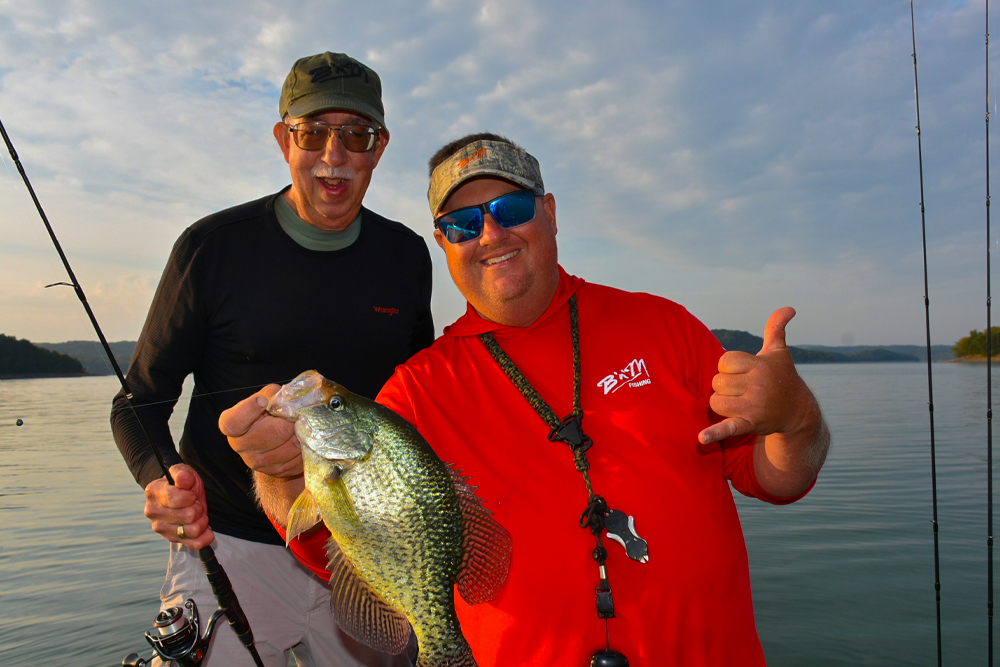
Mac Bray (left) and Dale Hollow guide Corey Thomas with a nice Dale Hollow crappie.
Many anglers are missing great opportunities and scenery by not fishing some of the
nation’s mountain lakes.
Going Deep on Dale Hollow
Story and photos by Richard Hines
Deep water can add complexity to crappie fishing, especially if you have never fished deep lakes. But I recently picked up some pointers from Dale Hollow crappie guide Corey Thomas.
Corey and I, along with my good friend Mac Bray, headed out to catch a few slabs in one of the country’s deeper lakes, Dale Hollow. To add to the complexity of fishing deeper water, we did it in late summer. Many crappie anglers view this combination as tough, but we were ready to try.
Dale Hollow is well-known and noted for producing the world-record smallmouth bass in the 1950s. While bass anglers continue casting the shoreline, crappie, as is true with most mountain lakes, are overlooked.
The high hills and deep valleys of the Cumberland Plateau made this area a natural choice when the nation began building numerous reservoirs back in the 1940s. I always remember older crappie anglers who had fished many of these lakes when they were first constructed saying, “We really caught them the first few years after the lake was built, but the crappie are gone now.” This attitude prevailed for many years until guides like Corey Thomas figured out how to master deep mountainous lakes.
When fishing deeper lakes, start thinking outside the “normal crappie box.” Just like in shallow lakes, crappie move to shallow areas in the spring and then deeper areas during the summer. However, like all lakes, when the spawn ends, so does angler interest. Anglers continue going to their favorite brushpiles, but give up over time because crappie patterns changed.
It’s all offshore, and many anglers still don’t understand offshore.
To catch crappie in the summer and in deep-water lakes, you must understand crappie habits. By midsummer, crappie habitat is offshore and in open water.
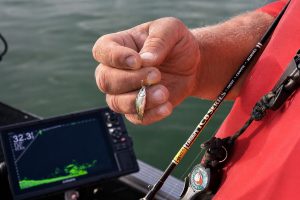
As we pulled out of the marina, Corey immediately moved us into some open flats to begin casting as we worked his LiveScope. We gradually shifted to even more open water where we found fish in what I call wide-open water, and this matches what adult crappie do in the summer. They move where baitfish are.
In almost all cases, adult crappie pick up the feeding pace by late June and continue consuming a wide range of food items through September. This includes everything from small invertebrates to large baitfish. They are getting the bulk of this food in open waters.
This is one of the most significant lifestyle changes that crappie make. The term is pelagic, meaning occupying open waters.
Also, something to keep in mind is their tendency to spend the hotter part of the day just above the thermocline, which is the cooler part of the lake. However, as the afternoon progresses, they may tend to move up a few feet. This is well documented by many fisheries researchers.
Crappie continue to move up to the warmer water as the sun sets to take advantage of the warmer water as night approaches.
Corey said, “They are in deep water…but not deep”. It all has to do with the basics of lake ecology. The normal seasonal changes that are going on in any large lake are impacting fish and particularly baitfish.
“The question is always, where is the bait?” Corey added. “You should know where the thermocline is, then plan to fish above it. Baitfish are in the flats and, in many cases, they are just out there schooled up.”
By late June, this is typically 18 to 20 feet, and as the summer progresses, this will change. Keep in mind that during the summer months, all lake life revolves around the depth of the thermocline. So, find this depth and you should find baitfish hanging in that 14 to 16 feet range in the deeper lakes.
Bait choice is important, but these bait choices may not be what you think. Consider using large baits. Don’t just think little baits all the time. Crappie Magnet makes a 3-inch alewife imitation that works well, and some anglers are going with medium-size crankbaits.
When all else fails, just use some finesse.
Corey calls it “ultra finesse,” and he sure likes to use a lot of finesse when fishing stubborn slabs. After they have had some angling pressure, forcing a crappie to bite can get to be work. So, he likes to “push the bite.” He lifts his bait up ever so slowly through a school of fish rather than reeling. As you lift, you feel the rod load up and you have the fish. Sometimes slow retrieves work when fish are pressured.
When finesse fishing, Corey downsizes with an ultralight two-piece rod, B’n’M’s Leland’s TCB Series 6 ½-foot 2-piece graphite ultralight rod. This rod is built to cast lures from 1/64 ounce on 2-pound-test line, ideal for small minnows and lures.
Corey said, “It has a very soft tip that allows you to pick up fish that are slow.” We were using minnows part of the day, and, in this situation, he prefers Mosquito Light No. 6 hooks, which allow tiny minnows freedom to move. To get the bait down, he uses a # 7 split shot.
“Don’t think about structure. Think bait,” Corey said. Many times, these baitfish are suspended in open waters far from cover, but remember, crappie won’t be far behind and don’t think your bait is too big.
In July and other summer months, you might be surprised what size they will bite, and even in deep water, they may not be as deep as you think.
For more information about Corey Thomas, check his website. For lodging information, check out Cedar Hill Marina in Celina, Tennessee or visit the Clay County Tourism website.
(Richard Hines is a retired wildlife biologist, book author and award-winning freelance outdoor writer and photographer. Since 1985, Hines has published hundreds of articles on hunting, fishing, conservation and natural history.)
