

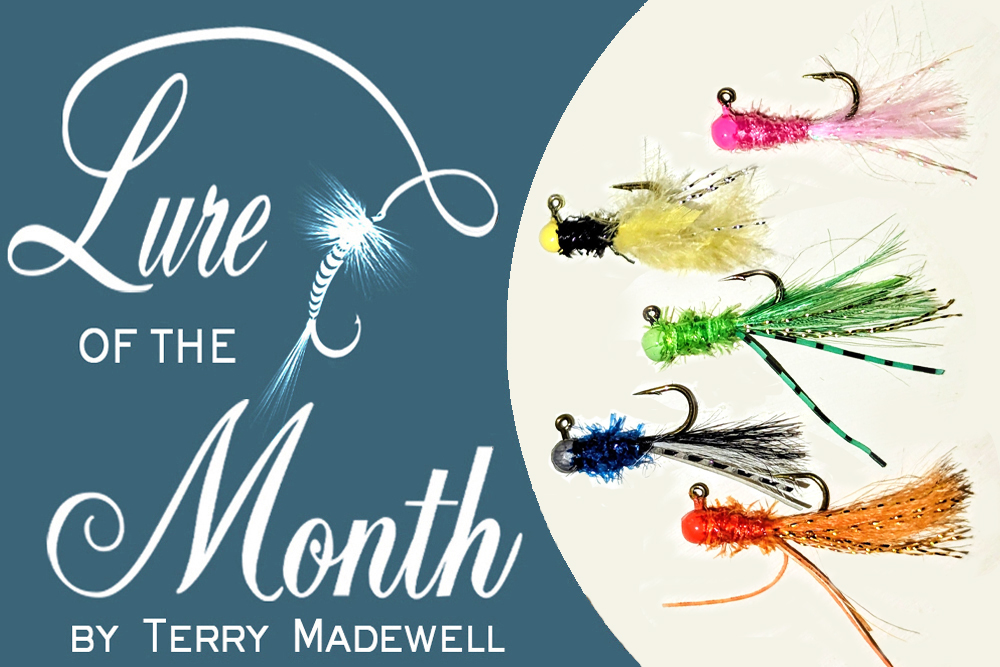
Lure of the Month: Herb Thompson’s Fishing Lures Green Crappie Jig
Story and photos by Terry Madewell
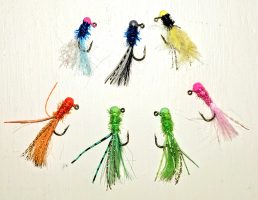
Herb Thompson enjoys creating tiny treasures by hand and loves catching crappie. Combining those traits on his personal quest to become a complete crappie fisherman, Thompson’s learning curve to catch more slabs paired well when he began making his own crappie jigs.
Thompson, from Darlington, South Carolina, is a jewelry maker who has sold his crafts commercially for 15 years. He’s learned various techniques for working with small, delicate mini-works of art. His skills with small beads, wire and jewelry components helped him easily transition to making crappie lures that mimic living forage.
His assortment of crappie lures includes many handcrafted jigs in various profiles and color schemes. But he focuses much effort on what his clientele wants, and he has a clear leader in that category. To Thompson, it’s called his Green Crappie Lure, and it’s available in 1/32- and 1/64-ounce sizes. It’s the February 2026 CrappieNOW Lure of the Month.
Thompson said his fishing lure quest began when his and his fishing buddy’s source of handmade lures was no longer available.
“We’d enjoyed fishing those handmade lures, and I thought, I can do that,” he said. His years of crafting experience, driven by a deep passion for crappie fishing, motivated him to perfect his lure-making skills.
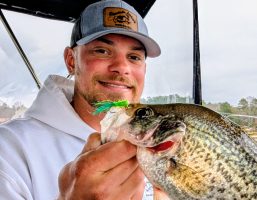
“I started by making and selling jewelry and learned the skill of working with small projects,” the 76-year-old Thompson said. “I’ve long had a passion for fishing, first instilled while fishing with my grandfather when I was a kid. I wanted to conduct my own lure design, research, testing and development because I believed it would make me a better fisherman. And it enables me to personally test every pattern of the lures that I sell.”
Thompson (843-621-0641; email; hct0641@live.com) said he doesn’t want to accept what others think he should use.
“I prefer to design and build what I believe will be a good jig, and test every pattern on the water to personally prove what works best,” he said. “I’ll tweak and refine my lures based on those fishing experiences, and when I tell someone this lure catches fish, I know it will because I did it myself. And I’m not a crappie fishing expert by any means. So, when they work for me, they’ll work for you.”
To consistently hook crappie, Thompson builds his lures with key factors required in each bait.
“I’ve learned that three things are crucial to making a finicky crappie bite,” Thompson said. “It must have lifelike movement in the water, something that mimics a baitfish or forage. Next, it must be the right color for the conditions fished, and third, a crappie lure needs flash. I incorporate all into every lure.”
Thompson builds his lures in three distinct segments. The first is the jighead; it’s made from lead and powder-coated in color. The body, the mid-section, is made of synthetic material.
“Synthetic materials differ greatly in flexibility, and I experiment with different types to ensure the synthetics on my lures flow naturally like a live minnow moves,” he said. “Some synthetics are too stiff, others too loose, and don’t look natural.”
The tail is synthetic, with several strands of silicon, and he adds the flash component throughout the midsection and tail.
“The flash patterns come in different color patterns and are subtle to mimic the flash I see on live forage in the water,” he said.
He uses a No. 8 hook that’s partly hidden in the lure, and it doesn’t impact the hook setting.
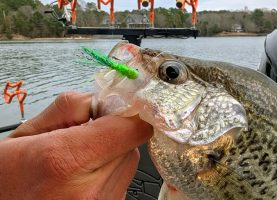
His most popular model, the green, is unique because the head, body and tail are all green, but different shades. With the flash added, it works in a wide variety of water situations.
“But I make several color patterns because when fishing muddy water, for example, I’ve learned a bright-colored lure has proven more effective in that extreme situation. Different patterns work in different fishing scenarios.”
Thompson said he’s happy to work with anglers to design custom lures tailored to their specific needs.
His pursuit of perfection mirrors that of passionate anglers, such as trout fishermen, who meticulously craft their own flies to fit specific conditions and match the unique hatch. He invests in each crappie jig as a personal art.
Crappie fishermen know that on some days, these fish are aggressive, but our target species is also known for their penchant for being persnickety. Those are the days when crappie lure craftsmanship matters.
(Terry Madewell of Ridgeway, S.C., has been an outdoor communicator for nearly 50 years. He holds a degree in Wildlife and Fisheries Management and has a long career as a professional wildlife biologist/natural resources manager. He’s passionate about sharing outdoor adventures with others.)
