

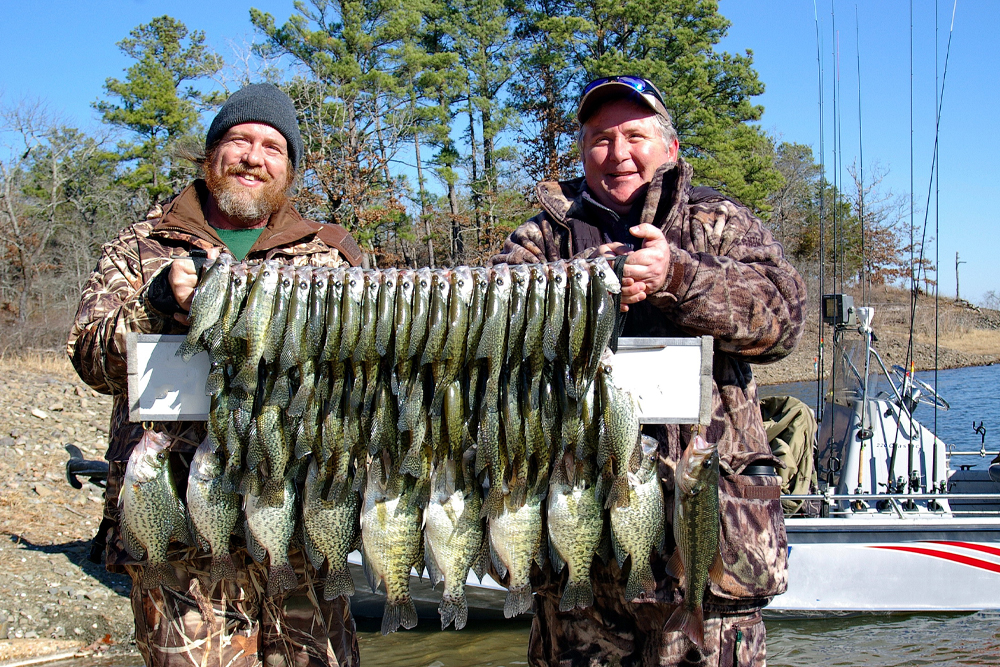
A late-winter fishing trip on Arkansas’ DeGray Lake often produces big
stringers of good-eating crappie for anglers like Keith Sutton and Alex Hinson.
Spring in the Ouachitas: DeGray and Greeson on Fire
Story and photos By Keith Sutton
Late February and early March in the Ouachita Mountains can fool you. The air may still have a bite, but the sun carries a warmth that hints at spring. On mornings when the light glints off glassy water and cedar-lined hills echo with geese overhead, crappie anglers across Arkansas know what’s coming. Prespawn slabs are sliding out of their deep winter haunts, gathering on cover, staging on points and slipping into warming coves. And in two of the region’s crown-jewel reservoirs—Arkansas’ DeGray Lake and Lake Greeson—the fishing can be nothing short of spectacular.
These Corps of Engineers lakes are beloved for their beauty, but in late winter, another quality stands out: both are absolutely loaded with crappie. With stable, clear water and thousands of acres of varied habitat, the Ouachitas offer everything a prespawn or early-spawn crappie wants—flooded buckbrush, warming shallows, creek arms that heat quickly and, perhaps most important, hundreds of man-made fish attractors placed by the Arkansas Game and Fish Commission and generations of local anglers.
The result is simple: in February and March, these lakes are on fire.
Cold Mornings, Hot Bites
I’ve spent many winter and early-spring days on these waters, and one trip still sticks with me. We launched in the kind of morning where your breath fogs instantly and the deck frosts over like a freezer door. But by the time we idled into a sheltered arm, the wind had died and the sun sat warm on our backs. We were bundled up like Eskimos, but the bobbers in front of us kept moving.
The setup was simple—color-coded slip floats suspending minnows above carefully placed brush. One bobber eased under, then another. Suddenly all four went down at once. Cold water or not, the crappie fought hard, racing through the brush with surprising energy. When I grabbed one fish, its sides felt like ice, yet it twisted like a midsummer slab.
That’s the magic of late-winter crappie. The bite may be subtle, but the fish themselves are thick, healthy and full of life. And as water temperatures begin climbing into the high 40s and low 50s around late February, these fish feed aggressively.
This is exactly the window anglers should target.
Finding Prespawn Fish
In winter, crappie often hold on deep structure and tight to cover, but late February sparks movement. Fish rise in the water column, shift toward mid-depth attractors and start staging at the mouths of coves, on secondary points and in standing timber. By March, they slide farther back, sometimes all the way to the buckbrush when conditions are right.
Both DeGray and Greeson are loaded with ideal staging areas. Artificial attractors built of bamboo and hardwood brush are everywhere—some deep for winter, some mid-depth for prespawn and many shallow for the spawn. Anglers who understand this depth progression can stay on fish all season long.
Slip-bobber rigs shine during this transition. A No. 6 light-wire Aberdeen hook tipped with a minnow and suspended beneath a pencil-style float is deadly. Move the bobber stop until your bait just ticks the top of the brush. On cold days, crappie may suspend 18–25 feet down; on warm afternoons, they often rise to 8–12 feet. A sensitive rod helps detect the light bites common in chilly water.
Hair jigs, especially squirrel-tail or marabou, also excel. Tie them so they hang horizontally, lower them to fish level and hold them almost motionless. A crappie will often inhale one without ever moving the line sideways.
DeGray Lake: Warming Water and Shallow Dreams
DeGray Lake, a 13,800-acre impoundment near Bismarck and Arkadelphia, is perfectly built for a strong late-winter prespawn bite. The lake’s upper end warms first, especially Brushy Creek, with its labyrinth of timber, submerged brushpiles and fish attractors. By late February, crappie gather in this arm in surprising numbers. Many anglers focus on brush 10–15 feet deep early, then follow fish upward as stable warming days push them shallower.
The Big Hill Creek area is another standout. Timbered coves there have long had a reputation for producing heavyweight slabs in the weeks before the spawn. If you fish this section, spend extra time near the breaks where shallow flats drop sharply toward the old creek channel—classic prespawn staging lanes.
From Point 15 upriver, DeGray narrows into a more riverine character. This upper stretch warms earlier than the main lake and offers a mix of standing timber, channel swings and man-made attractors. Crappie frequently stack along these ledges as they prepare to move shallow. When warming trends align with stable weather, they can appear in the buckbrush almost overnight.
The lake’s numerous underwater islands and ridges are also worth checking, especially those adorned with attractors. These structures draw big prespawn females that pause briefly to feed before sliding into coves.
For anglers needing current fishing information, fuel, bait, tackle or boat rental information, DeGray Lake State Park Marina is the go-to resource (501-865-5840).
Lake Greeson: Home of the Heavyweights
While DeGray is known for quantity, 7,000-acre Lake Greeson near Kirby is legendary for quality. I’ve fished many lakes that produce numbers of slabs, but few consistently turn out 2- and 3-pound crappie like Greeson.
One late February trip produced more than 50 crappie over a pound, with several pushing three. And that was before they ever sniffed the shallows.
Some anglers think Greeson doesn’t turn on until mid-March, but that’s simply not true. The late-February prespawn window is phenomenal. The lake is quieter this time of year—fewer boats, fewer jet skis, fewer distractions. Just timber, quiet coves and big, early-season crappie.
Slip-bobber rigs remain the top tactic here as well. Many attractors sit in water 20–30 feet deep, perfect for staging fish. Locals set their bobbers so the minnow barely ticks the brush tops, then watch carefully for the slightest twitch. On warm afternoons, crappie may move up to mid-depth cover, and a jig suspended a few feet above the attractor often gets hammered.
One key to Greeson is mobility. Electronics help determine whether fish are on a particular pile. If sonar doesn’t show crappie, don’t waste time—move to the next attractor. When you find a good one, limits come quickly.
Buckbrush, Warming Coves and the Turning of Spring
By early to mid-March, especially following warm rains, both lakes can erupt with shallow activity. Crappie flood into willow thickets, flooded buckbrush and the backs of warming pockets. The best areas are those where a small channel or ditch connects deep water to the shallow zone. Fish use these as highways.
Long poles, light jigs and small minnows excel in the brush. Present the bait with minimal movement to capitalize on the crappie’s propensity for holding tight to one small spot in cold water. On sunny afternoons, they may spread out and feed more aggressively.
It’s a magical time—birds calling, redbuds blooming and slabs stacked so thick you can catch a limit before most folks finish breakfast.
A Perfect Place for Spring Crappie
The Ouachita region’s lakes are as scenic as they are fertile, with crystal-clear water, rugged mountains and abundant wildlife. Add thriving crappie populations, and it’s no surprise these reservoirs are on so many anglers’ spring must-fish lists.
Whether you prefer the vast, structure-rich expanses of DeGray or the trophy-slab reputation of Greeson, February and March offer some of the best crappie action of the year. Bundle up, launch early and follow the warming shallows. If you hit the timing right, you may find the lakes on fire, just as thousands of Ouachita anglers do each spring.
(CrappieNOW editor Keith Sutton wrote The Crappie Fishing Handbook: Tackles, Lures, Bait, Cooking, Tips, Tactics, and Techniques, a 208-page full-color guide full of practical tips that will help you catch more fish. Copies are available on Amazon.com.)
