

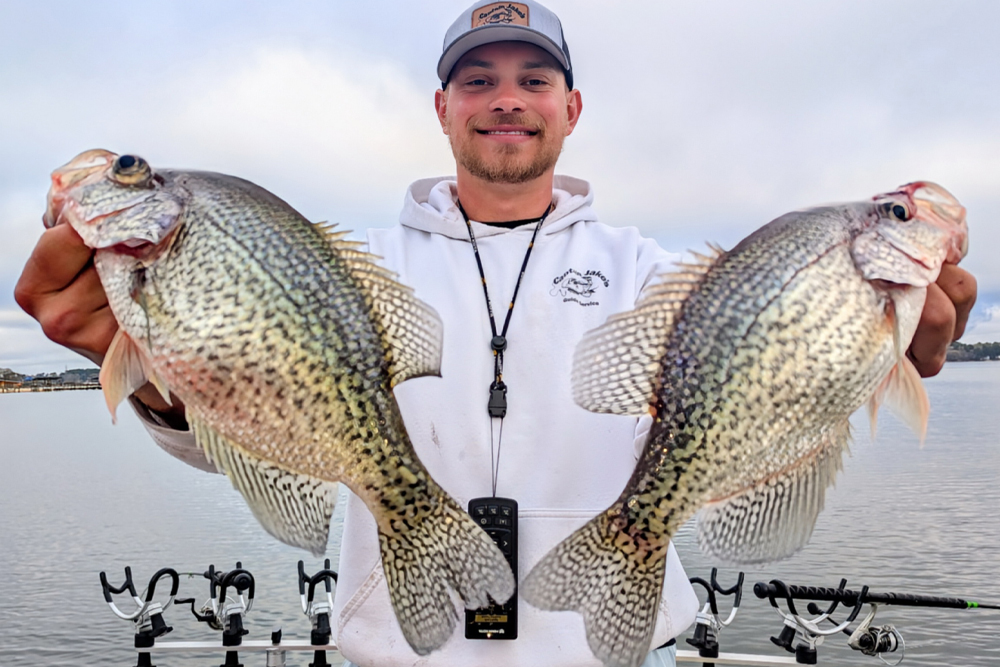
Captain Jake Futia said crappie are available all year,
but anglers must follow their seasonal movements.
Summertime Slabs
Story and photos by Terry Madewell
Hot summer weather often leaves crappie anglers reflecting on productive spring fishing when the annual crappie migration to the shallows to spawn was underway. Warming water had crappie active and usually in feeding mode. It truly is one of the best times of the year.
But excellent crappie fishing doesn’t stop simply because the calendar moves on. In postspawn, the fish migrate back to summertime haunts, often deeper water, orienting to cover of various sorts. While perhaps not in massive groups as they are in late winter and early spring, crappie relate to definable locations accessible to anglers.
According to Capt. Jake Futia, a crappie (and catfish) fishing guide on Lake Wylie on the North and South Carolina border, finding the specific locations is the key.
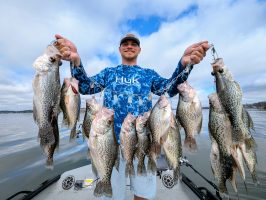
“Crappie are active as the water temperature warms, and their higher metabolism rate dictates they need to eat,” Futia said. “Summertime ushers in new patterns and depth preferences from the winter and spring, but once we pattern what they’re doing on the specific lakes targeted, anglers can enjoy stable, predictable patterns for catching crappie during the summer.”
Futia (704-989-1871; check his website) said that productive patterns are typically associated with deeper water, with fish relating to specific cover such as brush, stumps, fallen trees and other submerged cover.
“At Lake Wylie, and most places I’ve fished, woody or vegetative cover becomes a key to finding crappie in hot weather,” Futia said. “But the depth varies throughout the summer, and it’s still a game of cat and mouse for finding crappie on a given day, or time of day. I’ve found that crappie still move to different depths and locations within a general area, but the constant is that they orient to cover. Part of that is they’re following forage; the other is reacting to water conditions as summer progresses. In lakes where a thermocline sets up, that becomes an important factor in determining depth patterns.”
Futia said keeping an open mind about crappie location is crucial, and not getting locked into specific locations, although where he found them yesterday is a good place to begin the next day.
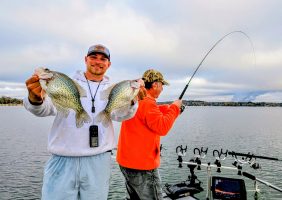
“But I’m not shocked when they’ve moved on to new locations,” he said. “It’s simply a matter of crappie being where you find them on a given day. So, have a mindset that searching is part of your daily game plan, even if it’s only a change in depth preference.
An important key for me is that I’m fishing nearly every day, which helps me make informed decisions about where to search next.”
Futia employs traditional sonar and Forward-Facing Sonar (FFS), and doesn’t rely solely on either. He uses them in tandem.
He said crappie don’t roam in huge schools during summer as much as they do during winter, but he occasionally finds that pattern to be productive, particularly around large brushpiles.
“I’ve found active clusters of crappie suspended over the top of brush, and these fish are often in an aggressive feeding mode,” he said.
Futia’s go-to bait for summertime (and year-round fishing) is live minnows, but jigs are often highly productive.
“My choice depends on the skill of the anglers, and since I’m often guiding families or a group of friends wanting to enjoy catching fish, minnows are the most consistent,” he said. “But if I have skilled anglers who prefer to cast jigs, that’s what we’ll do.”
Futia said presentation is always key for catching crappie, and his live-bait presentations are detail oriented.
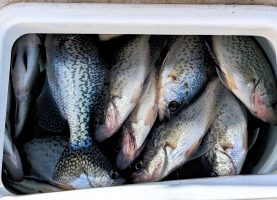
“Once I find crappie on the graph or Livescope, I have a couple of tactics I employ, based on how the fish are positioned,” he said. “If they stacked tight to the cover in one general area, I’ll position the boat so we can fish tightlines vertically. I’ll use a two-hook rig most of the time to cover a wider range of depths, and we’ll drop the rig to the depth indicated on the sonar. I specifically use long, 12-foot rods to keep the boat away from the fish.”
He said he’ll also find crappie orienting to bottom cover, such as stumps along an old river or creek channel, and that many fish will be available but scattered over a larger area. In this situation, Futia will use his electric motor to slowly move along the ledge or a specific depth contour with two-hook rigs near the bottom.
“We’ll need to cover more area in this situation, but the fish action is usually consistent, and along with crappie, we’ll catch bonus catfish and big white perch,” he said. “Depth is always crucial for crappie. It’s essential to keep the lure at the depth crappie are holding on that day.”
Futia likes minnows for summertime fishing because they’re the “real thing,” he said. His two-hook rig consists of a 3/8- to 1/2-ounce bell sinker on the terminal end. The bottom hook is about a foot up the line, and the second hook is about 12 to 18 inches above it, all rigged on 10-pound-test line. This rig enables him to work two depths effectively.
“This rig is effective throughout the summer,” he said. “I like a number-six wire hook because it’s small and enables the minnow to work naturally.”
Futia said his rigs are key as well. He prefers 12-foot Catch The Fever, medium-heavy-action rods for fishing minnows or jigs vertically or bumping along the bottom.
“They’re ideal for year-round fishing, and having all my rigs with the same length and action helps my anglers have the continuity of feel to catch fish consistently,” he said.
“Finding crappie is a daily process, but it’s productive. Fishing every day gives me a head start because I know what’s been happening, providing me a starting point. But anyone with a depthfinder and due diligence can find and catch crappie in the summertime.”
(Terry Madewell of Ridgeway, South Carolina, has been an outdoor communicator for nearly 50 years. He holds a degree in Wildlife and Fisheries Management and has a long career as a professional wildlife biologist/natural resources manager. He’s passionate about sharing outdoor adventures with others.)
