

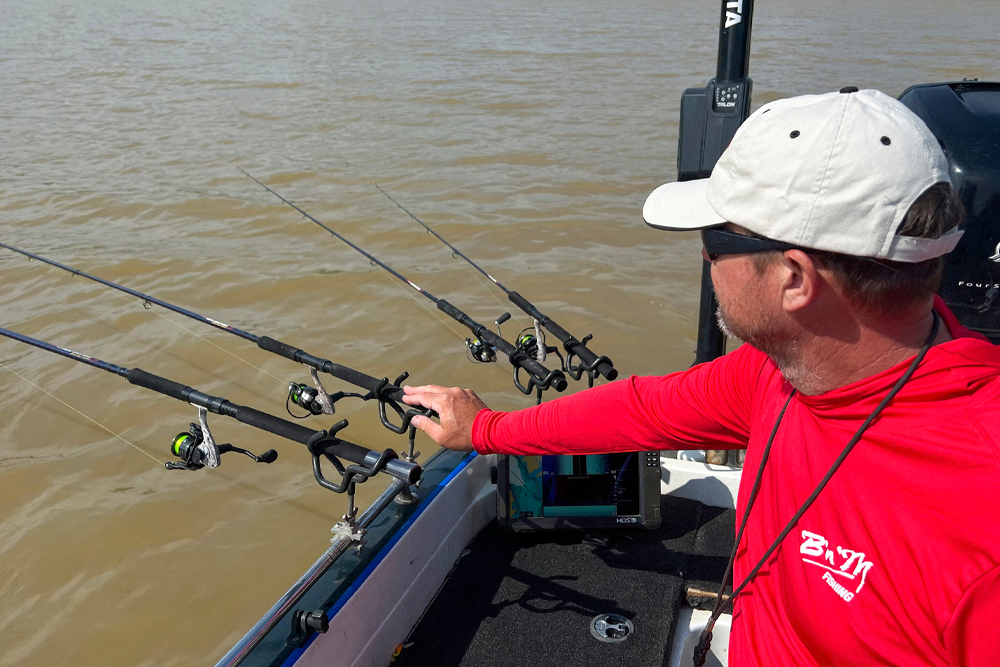
Brad Chappel is a pulling expert who focuses on Mississippi lakes.
His setup for pulling jigs is an efficient and effective way to pull.
Three Tactics for Non-Forward-Facing Sonar Crappie
Photos and Story by Tim Huffman
Forward-facing sonar is efficient and a great tool for catching crappie. However, not everybody wants to spend all day scanning and looking at a screen. It is fun being surprised by a bite instead of knowing it’s coming.
The following are three techniques that worked before high-tech electronics and they still do today.
Shallow-Water Jigging
Louie Mansfield, owner of Grizzly Jig Company, has logged many hours catching crappie and bluegills at Reelfoot Lake. Crappie tournament fishing has taken him to other lakes, too, where he and his partner once held the 10-fish tournament record stringer. He is old-school smart, learning how to fish with basic electronics. He says a fisherman can have fun and be successful without spending a fortune.
“There’s nothing like putting a jig beside a piece of wood cover or vegetation and getting a bite,” says Mansfield. “You don’t see the fish ahead of time on electronics. You anticipate the bite and have a fun surprise when it hits.
“There are many good poles for jigging, but I use my own 10-foot Grizzly Pro Balance. Balance means everything when it comes to better sensitivity and feeling more bites. I’m usually fishing around trees with overhanging cypress tree limbs, so the shorter length works for jigging under the limbs. I like a 1/16-ounce plastic jig when crappie are active and our 1/32-ounce feather Grizzly Jig when the bite is tough. I like to add a waxworm or Crappie Nibble.
“I usually pitch against or past a tree and let the jig fall. Sometimes the bait will have to be kept still for a long time, but normally they’ll hit quick when they are hungry.
“My presentation is simple and my equipment simple. I use basic electronics. What worked 50 years ago still works today. No technique is more economical and fun. You get to feel the fish hit, set the hook and land it.”
Pulling Jigs
Pulling, or long-line trolling, is another technique that is fun and effective. Multiple baits and a very easy-to-learn system make this a great choice for any lake with enough open water to troll. It finds and catches fish.
Mississippi guide Brad Chappell is pro staff for B’n’M Poles and Bobby Garland and is host of the Crappie Connection podcast. He says pulling jigs isn’t difficult, but there are gear requirements to do the job right. First is a remote-control trolling motor that allows a constant speed and control in any conditions because a consistent speed is critical for knowing jig depth.
“My poles are B’n’M Pro Staff Trollers in 8-, 12-, 14- and 18-foot lengths,” Chappell says. “The lengths give line separation. The 8-foot pole is closest to the boat. All poles are horizontal, 12 to 24 inches from the top of the water. I use Driftmaster rod holders.”
Chappell uses 6-pound-test monofilament, alternating color on alternate poles because it helps untangle lines. Baits are Bobby Garland Stroll-R jigs that provide great vibration. Baits are 1/32- to 1/8-ounce jigs in tandem. He uses Road Runner heads most of the time.
“I’ll use Side Imaging to see where the fish are in the water column and learn if shad are in the area,” he says. “Shad are important any time of year. I want to see them in tight balls because that means they are scared and being chased.
“I cast my jigs out ‘just a good ol’ cast.’ For me, that’s about 70 to 80 feet. The boat doesn’t stop until all jigs are returned to the boat. I’m opposite of most fishermen because I start fast at 1.2 mph. I want to cover as much water as possible to find the most active fish. I only go slower if necessary.”
Jig weights determine the depth. He says to stick with one body style and learn the depth for each weight versus speed. He uses two jigs, but says beginners are best starting with one. Change sizes to change depths if not catching fish.
“Pulling is a great technique that allows a five-year-old, or the most elderly, to do it,” says Chappell. “It’s a technique to enjoy and be successful. Crappie are spookier today than ever before, so pulling helps keep baits away from the boat.”
Pulling Crankbaits
Similar to pulling jigs, pulling crankbaits is a great technique for covering a lot of water, finding fish and catching fish. Mitch Glenn, owner of Pico Lures, has deep- and shallow-running crankbaits that catch crappie.
“My main line is 30-pound-test braid and my leader is 12-pound-test monofilament line,” he says. “Crankbaits are Pico INT and Pico Square Bills. I bass fish a lot, too, so I use a cable-driven trolling motor, and I pull from the front of the boat. It’s not ideal for sure, but the motor works for multiple-species techniques.
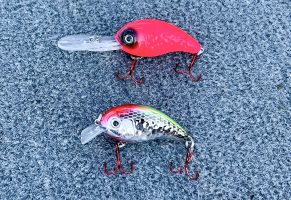
“Crankbaits are good from the spawn until there is serious cold weather in the fall. However, I believe you can catch fish on crankbaits all year long. But when they move more to cover and get deeper, there are other techniques more efficient, like pitching to a boat dock, downed tree or a bed. However, that said, I fished with a guy on Lake Washington who was trolling Square Bills (shallow-running crankbaits) on planer boards and was catching fish.
“You can trial-and-error your line lengths until you learn the right depth, but you should turn on the electronics and see where the shad are located. Fish feed up, so if the shad are 10 to 12 feet deep, your baits need to be at 9 or 10 feet. I believe when you start catching catfish, you are too deep because they usually feed deeper than crappie. So, if you catch them, bring your crankbaits up.”
Glenn likes to run the channels when fishing rivers, but on big lakes like Grenada, flats seem to produce the best. He says colors vary with different seasons and water colors, but blue chrome works great in his home waters.
“I like to start at 1.4 mph,” he says. “If I get a hit while turning, I’ll see if it’s on an inside or outside pole. If it’s on an outside pole when turning, I know I need to speed up when going straight because the outside poles go faster in a turn. Fish usually get more aggressive after mid-morning. As you speed up, the reaction bite becomes more important than the color, although color is usually important. I’ve run as fast as 2.2 mph and caught fish, but that’s rare for me to run that fast.
“Don’t set the hook with crankbaits,” Glenn concludes. “If you let a fish run for a few seconds, he will ski to the top of the water. I don’t use a net unless I think the fish is over 2 pounds.”
Final Comments
Forward-facing sonar is outstanding technology and is highly recommended by most experts. However, cost, learning and screen watching are negative factors to some fishermen, and some say simpler is just more fun. Try one or more of the techniques mentioned here to successfully take crappie right now.
(CrappieNOW senior writer and Fresh Water Fishing Hall of Fame member Tim Huffman has several books, including his newest, Papermouth, Modern Fishing Techniques, available in Kindle or paperback at Amazon, or link from his website, www.monstercrappie.com)
