

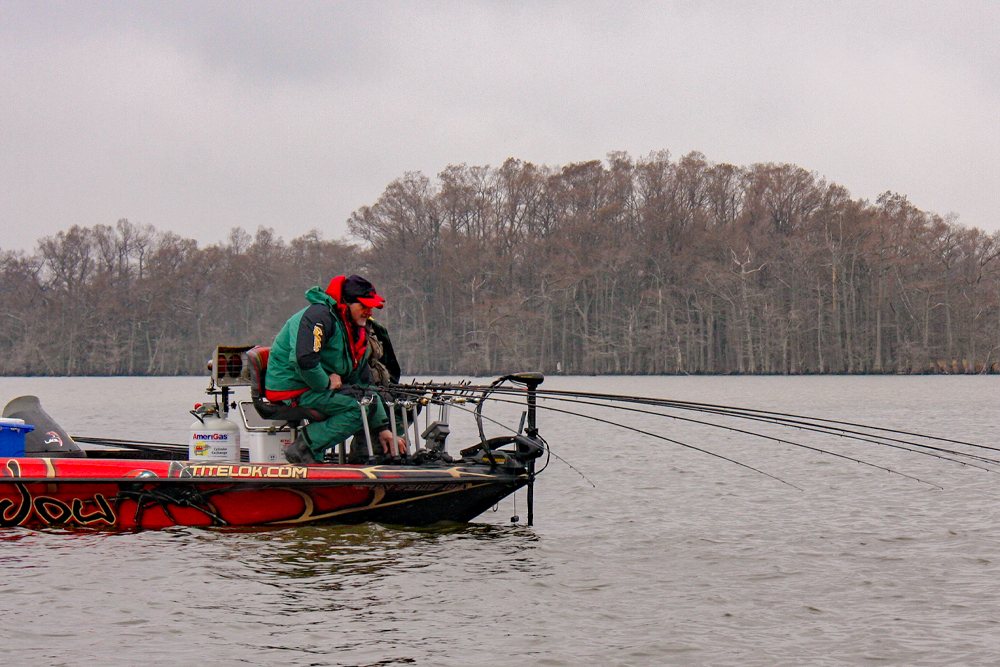
One of the author’s favorite tournament photos was taken years ago during a cold,
winter tournament on Tennessee’s Reelfoot Lake. National champs Ronnie Capps and
Steve Coleman slow troll their home waters, demonstrating that using a stealth
technique and being quiet pays dividends in more bites.
Top 10 Crappie Fishing Tips for 2026
Story and photos by Tim Huffman
CrappieNOW.com Senior Writer Tim Huffman begins the New Year with his Top 10 Tips for successful crappie angling.
1. Quiet & Stealth
“Be quiet. You’re scaring the fish!”
That’s what we were told when growing up learning to fish. Some fishermen disagree on this belief because they remember situations where they’ve been noisy and have caught fish anyway. The key is: spookiness of a fish is proportional to its size. Just like a big buck gets smarter and spookier every year, the biggest crappie are the spookiest. Therefore, a fisherman may still catch fish despite making noise, but they’ll likely not be the biggest fish in the area.
Forward-facing sonar (FFS) has revealed that dropping something in the boat, walking heavy footed in the boat or even something so subtle as a jig splashing on top of the water, will send a spooky fish running. Start the new year with a resolution to be as quiet and stealth as possible whether fishing from the bank or a boat.
2. Simple Techniques
A weekend fisherman should consider keeping things simple. One technique that’s versatile and easy is a slip-float and minnow. A slip-float rig can be used in shallow to deep water. The rig consists of a minnow hook on bottom, a small sinker or split-shot six to ten inches above the hook, a slip-float, small bead and a bobber stop. After a cast and the rig hits the water, the sinker pulls line through the float until it gets to the bobber stop. The stop is tied or otherwise attached to the line and can be slid to set or change depth. A fisherman can cast, watch to ensure the bobber stop reaches the float, let the minnow do the work, and watch the float for an indication of a bite. It’s simple, can be fished almost anywhere and at any depth.
3. Casting
Sometimes watching a float doesn’t keep a fisherman engaged. Casting and retrieving is a good way to keep busy and cover a lot of water. One enemy of casting is heavy cover or fast current. Otherwise a cast can be made to any depth water using a wide variety of baits. A general rule is to use six-pound-test line and a 1/32-ounce jig in shallow water. Use a 1/16-ounce jig in mid-depths and deep water. A heavier 1/8-ounce jig can be used but retrieve speed will likely be too fast for crappie.
4. Casting Baits
A tip for casting is to use bait with some action. Of course live minnows work but for artificial lures, a curly-tail jig has been the standard jig body for decades. The curl in the tail provides a fast visual impact and vibrations while retrieving. An addition to the tail is a Road Runner–style head with an underbody spin. The head provides a flash and more vibration. The key is to reel as slowly as possible but not too slow to prevent the blade from rotating.
5. Slow Down
Another trick that forward-facing sonar taught us is to not jig baits. We once believed that hopping a jig a few inches was the ideal way to trigger a strike from a lazy fish. FFS shows that crappie usually swim away from a bait that’s hopped. Fish do like a bait that is slowly swam or allowed to pendulum down. To keep it simple, a fisherman can’t go wrong by slowly dropping a bait and then holding it still. Aggressive fish hit immediately while others might take a minute or more to grab the bait. Slow your bait down and give plenty of time for a bite when fish are sluggish.
6. Summertime Live Bait
A jig can work great and is less trouble than messing with minnows. However, summer is a great time to go live. Possibly due to stress caused by summer hot water, fish get finicky about what they eat. Minnows have proven a good choice. Stick with medium and large minnows in stained waters. Another trick is to use wax worms. Two or three can be added to a bare jighead to create a small but inviting live meal.
7. Put Your Tacklebox on a Diet
Fishermen don’t like this tip. They always want more baits because there might be a time they’ll need them. Also, baits are just fun to buy. The baits can require multiple boxes and boat storage space. By culling to a dozen colors, fishing becomes much simpler. You don’t have to search forever to find a color and you’re not worrying about switching colors all the time. There could be a particular lake color needed if you go to a different body of water. Pick two body styles, one for pitching and jigging, and one style for trolling and casting. Store the rest. While purging, get rid of odd tools and gadgets you don’t use but have kept in the box or boat for years “just in case”.
8. Spawn
Spring spawn is an easier time to catch crappie because they get into shallow water. These shallow areas have great male crappie action along with a few females. Go to a little deeper water, often the first underwater drop-off, for bigger female crappie waiting to go shallow. Catch them before the transition.
9. Don’t Panic
A huge fish, especially when unexpected, can cause an adrenaline rush and panic. You put more pressure on the fish. You start looking or grabbing for the net. A lot of panic things can happen. Try to keep your cool. It’s difficult but if you practice doing this on smaller fish it will help when the big one hits.
10. Have Fun
It’s easy to feel pressure to catch fish. Catching fish is the goal but so is enjoying the day on the water, watching an eagle fly or a deer getting a drink of water. Don’t focus so much on catching fish that you miss the outdoor experience.
CrappieNOW senior writer and Fresh Water Fishing Hall of Fame member, Tim Huffman, has several books, including his newest, Papermouth, Modern Fishing Techniques, available in Kindle or paperback at Amazon, or link from his website, www.monstercrappie.com
